
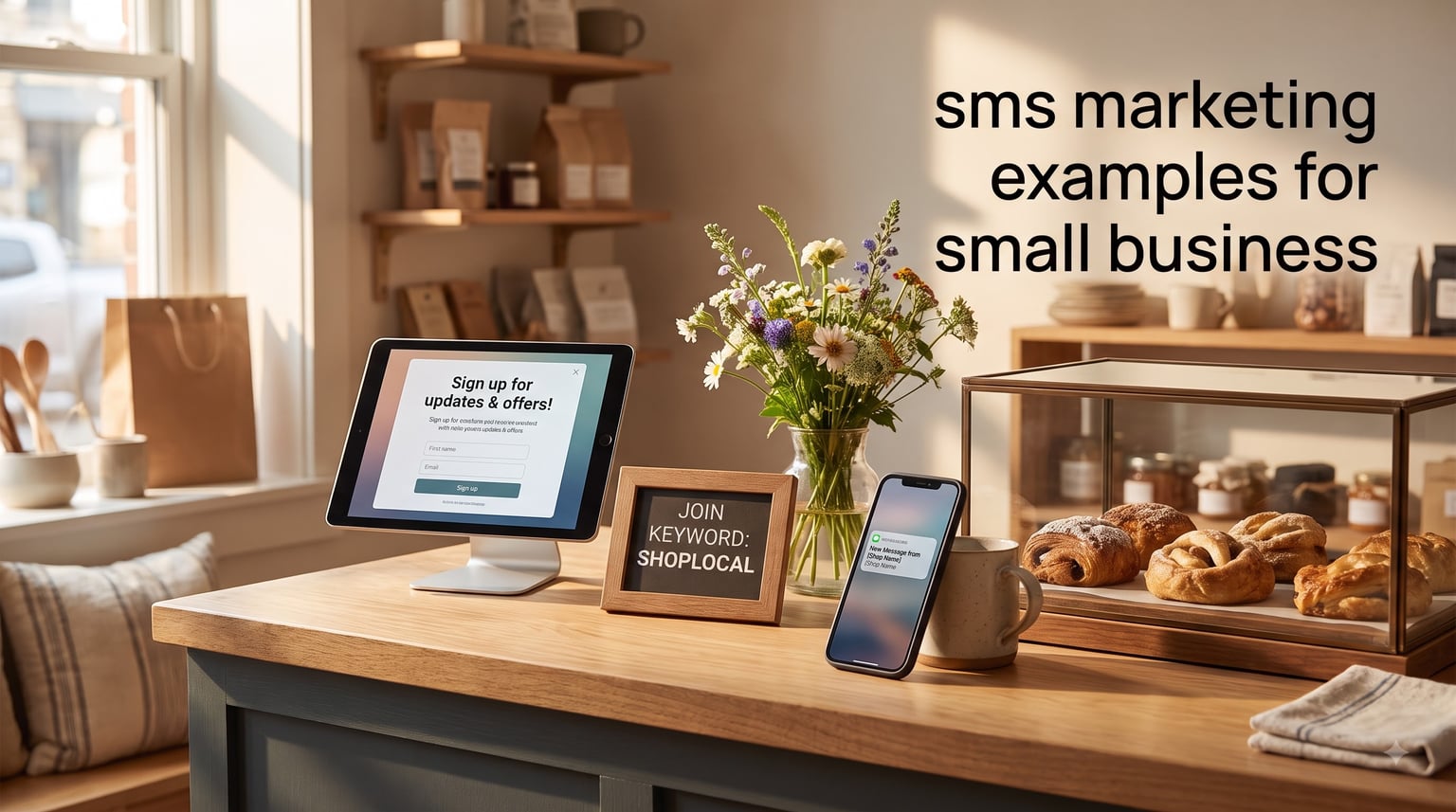
SMS marketing examples for small business are everywhere once you start looking – the flash sale alert from your favorite boutique, the appointment reminder from your hair salon, the abandoned cart nudge from that online shop you visited last week. If you run a small business and have wondered whether text message marketing could actually work for you, the short answer is yes, and the proof is in the open rates.
I put together this guide after watching my friend grow her ceramics studio list from zero to 1,400 subscribers in four months using only SMS. In this article, I’ll show you 15 real SMS marketing examples for small business owners, explain the hook-offer-CTA formula that makes messages convert, walk through TCPA compliance so you don’t get fined, and give you templates you can copy today.
Table of Contents
What Is SMS Marketing for Small Business
SMS marketing for small business is when a local shop, service provider, or ecommerce store sends short promotional or transactional text messages to customers who have explicitly opted in to receive them. Each message is limited to 160 characters, lands directly on the customer’s phone, and usually includes a link to a landing page, product, or booking form.
The way SMS marketing works in practice is straightforward: a customer texts a keyword like “JOIN” to a short code or long code number, or fills out a web form that captures their phone number with explicit consent. The business then uses an SMS platform to send broadcasts or automated flows triggered by customer behavior, such as an abandoned cart, a birthday, or an upcoming appointment.
For small businesses, SMS is uniquely powerful because you don’t need a massive marketing team to execute it. A bakery with 200 customers on its list can send a “Fresh croissants just came out of the oven, come by before noon!” text at 9 a.m. and fill the store before lunch. That kind of immediacy and intimacy is hard to replicate on email or social media.
Why SMS Marketing Works: Key Statistics and Benefits
Text message marketing works because nearly every text gets opened, and most get opened within minutes. Industry data consistently puts SMS open rates at 98%, with 87% of messages read within 15 minutes of receipt. Compare that to email, where average open rates hover around 21% and click-through rates sit near 2.6%, and the case for SMS becomes obvious.
The benefits for small businesses compound quickly. Click-through rates on SMS run between 8% and 15%, depending on the industry and offer. Conversion rates from SMS traffic average 29% for ecommerce, more than five times higher than email. For service businesses like salons and gyms, SMS-driven bookings typically account for 30% to 40% of all appointments within the first six months of launching.
Beyond raw numbers, SMS gives small businesses three strategic advantages: direct access to customers without algorithm interference, instant communication for time-sensitive offers, and a channel that customers actually want to receive messages on. Surveys show 75% of consumers like receiving SMS offers because they feel convenient rather than intrusive. That sentiment is gold for a small business owner running on tight margins.
Legal Requirements: TCPA, Consent, and Compliance
Before you send your first SMS marketing message, you need to understand the Telephone Consumer Protection Act (TCPA) and the consent rules that come with it. The TCPA is the U.S. federal law governing marketing texts, and violating it can result in fines of $500 to $1,500 per message. A small business that blasts 5,000 texts without consent could face a $2.5 million lawsuit.
The good news is compliance is simple when you build it into your signup flow. Here’s what you need to have in place:
- Express written consent: Customers must clearly agree to receive marketing texts. A checkbox that says “I agree to receive marketing SMS from [Your Business]” must be unchecked by default and clearly visible at signup.
- Clear disclosure of message frequency: Tell subscribers how often they’ll receive texts, for example “You’ll receive up to 4 messages per month.”
- Message and data rates disclosure: Include “Msg & data rates may apply” in your signup copy.
- Opt-out instructions in every message: Every SMS must include a way to stop, usually “Reply STOP to unsubscribe.”
- Record-keeping: Save the timestamp, IP address, and exact consent language for every subscriber.
If you operate in Canada, CASL (Canada’s Anti-Spam Legislation) has similar but stricter rules, requiring implied consent for existing customers in some cases. In the European Union, GDPR applies, and you’ll need explicit opt-in plus a documented lawful basis for processing. Always check your local regulations, and when in doubt, talk to a lawyer before launching.
The Hook-Offer-CTA Formula: How to Write SMS Messages That Convert
Every high-performing SMS marketing message follows a simple four-part formula: Hook, Offer, Call to Action, and Brand Signature. I learned this framework from watching brands like Glossier and Athletic Greens run their texts, and it translates directly to small business campaigns.
The Hook is the first one to three words that earn the reader’s attention. Strong hooks create urgency, curiosity, or relevance. Examples include “Just for you,” “Last chance,” “Flash sale,” or “Your appointment.” Avoid generic openings like “Hello” or “Greetings from [Brand]” because they waste precious characters before delivering value.
The Offer is the meat of the message – what the customer gets. Be specific: “20% off,” “free shipping over $50,” “buy one get one,” or “extra hour on us.” Vague offers like “special deal” or “limited time” underperform because customers can’t visualize the value.
The Call to Action (CTA) tells the customer exactly what to do next. Use action verbs and remove friction: “Shop now,” “Book your slot,” “Claim yours,” or “Show this text at checkout.” Always include a link if you’re sending a promotional SMS – the link is where the conversion happens.
The Brand Signature identifies who the message is from. It usually goes at the end of the message and helps with recognition, like “- Bloom Florals” or “- Pete’s Pizza.” Some brands use emojis here, others use a short tagline.
Putting it together: “Flash sale! 25% off all succulents today only. Shop now: [link]. – The Greenhouse Co.” That’s 90 characters and includes all four elements. You have 70 left for personalization, urgency words, or extra details.
15 Real SMS Marketing Examples for Small Business
Here are 15 SMS marketing examples for small business owners across the most common campaign types. Each follows the hook-offer-CTA formula and stays under 160 characters. Swap in your own offer details and send.
Welcome messages set the tone the moment someone subscribes. Use them to set expectations and deliver an instant incentive.
- “Welcome to Bloom Florals! Here’s 15% off your first order. Use code HELLO15 at checkout. Reply STOP to opt out. – Bloom”
- “You’re in! Thanks for joining Pete’s text club. Watch for VIP deals & pizza drops. Reply STOP to unsubscribe. – Pete’s Pizza”
Promotional campaigns drive revenue from your existing list. Pair them with seasonal hooks for higher engagement.
- “Spring sale is live! 30% off all dresses through Sunday. Shop the collection: [link] – Magnolia Boutique”
- “Members only: $10 off any service this week. Book your appointment: [link]. Reply STOP to opt out. – Glow Studio”
Flash sale alerts create urgency that converts browsers into buyers within minutes.
- “FLASH: 40% off everything for the next 4 hours only. Don’t sleep on this: [link] – Trail Outdoor Co.”
- “2-hour flash sale! Buy one candle, get one free. In-store only. Show this text. – Wick & Wax”
Abandoned cart recovery recaptures shoppers who left without buying. Send 1 to 3 hours after abandonment for best results.
- “You left something behind! Your cart is waiting with free delivery today. Complete your order: [link] – Olive & Oak”
- “Still thinking it over? Here’s 10% off to help you decide. Expires at midnight: [link] – Verdant Beauty”
Appointment reminders reduce no-shows by 30% to 50% for service businesses. Send 24 hours before the appointment.
- “Hi Sarah! Reminder: your haircut is tomorrow at 2pm with Jamie. Reply C to confirm or R to reschedule. – Studio 12”
- “See you tomorrow at 6am for your hot yoga class! Bring water. Reply STOP to opt out. – Sunstone Yoga”
Loyalty rewards keep your best customers coming back and feeling valued.
- “You’re our VIP! Enjoy a free upgrade on your next visit – just show this text. Thanks for being loyal! – Tide Cleaners”
Birthday messages drive high conversion because they feel personal and arrive when customers are celebrating.
- “Happy birthday from all of us at Riverstone Bakery! Enjoy a free cupcake on us today. Just show this text. – Riverstone”
Re-engagement campaigns win back customers who haven’t purchased in 90+ days. Offer something strong to break the dormancy.
- “We miss you! Here’s 25% off to welcome you back. Use code WELCOME25 anytime this month: [link] – Field & Forge”
Order and shipping updates are transactional but still build brand affinity and reduce “where’s my order” support tickets.
- “Your order #4821 shipped today! Track it here: [link]. Thanks for shopping with us. – Maple Goods”
Review requests sent 3 to 7 days after delivery can lift your review volume by 3x compared to email requests.
- “How was your new coffee maker? We’d be grateful for a quick review – it takes 60 seconds: [link]. Thanks! – BrewLab”
Industry-Specific SMS Examples for Service Businesses
If you run a salon, restaurant, gym, or local retail shop, your SMS playbook looks slightly different from ecommerce. The goal shifts from driving online purchases to filling chairs, tables, classes, and registers. Here are examples tailored to each.
Hair salons and barbershops should send a confirmation immediately after booking, a 24-hour reminder, and a same-day reminder 2 hours before the appointment. Add a “we miss you” text 8 weeks after the last visit to reactivate lapsed clients. Example: “Hi Maria! It’s been 8 weeks since your last cut. Your stylist Ava has openings Thursday. Book: [link]. Reply STOP to opt out. – Shear Co.”
Restaurants do well with limited-time offers tied to slow nights, weekend reservation nudges, and loyalty rewards. Example: “It’s quiet tonight and the kitchen wants to cook for you. Show this text for a free appetizer with any entree. Walk-ins welcome until 9. – Luma Bistro”
Gyms and fitness studios benefit from class reminders, membership renewal nudges, and seasonal challenge prompts. Example: “Your 30-day challenge starts Monday! Reply READY to join or STOP to opt out. – Iron Loft Fitness”
Local retail boutiques lean on new arrival alerts, VIP early access, and event invitations. Example: “VIP early access! Our fall collection drops tomorrow at 10am – shop 2 hours before the public. Your code FIRSTLOOK: [link]. – Wren & Co.”
SMS Marketing Best Practices for Small Business
Even with great copy, sending too many texts at the wrong times can blow up your list. Here are the best practices I follow when working with small business clients on SMS strategy.
Frequency matters more than volume. Two texts a month keeps engagement high. Four texts a month is the maximum sweet spot for most consumer brands. Going above once a week for non-transactional messages triggers unsubscribes. The data is consistent across verticals – opt-out rates climb sharply after the eighth message per month.
Send at the right time. The best windows for SMS marketing are 10 a.m. to noon and 6 p.m. to 8 p.m. in your customer’s local time. Avoid 9 p.m. to 8 a.m., weekends before 10 a.m., and major holidays unless the message is directly tied to the holiday. Appointment reminders are the exception – those should send when they’re useful, not when they’re “optimal.
Personalize when you can. Including the customer’s first name lifts click-through rates by an average of 26%. Most SMS platforms let you insert a {{first_name}} merge tag that pulls from your contact record. Pair the name with relevant segmentation – don’t send a “free kids shoes” offer to someone who only buys women’s sandals.
Use two-way messaging for service businesses. Two-way SMS lets customers reply with questions, appointment changes, or feedback. Restaurants, salons, and home service providers see huge gains from this. It also humanizes your brand in a way that one-way blasts cannot.
Test and iterate. A/B test your hooks, offers, CTAs, and send times monthly. The winning combinations shift with seasons, audience growth, and product mix. Run each test for at least two weeks before declaring a winner, and track click-through and conversion, not just opens.
How to Build Your SMS Subscriber List
Your list is the engine of SMS marketing, and small businesses often struggle here because they don’t have the same ad budgets as big brands. The good news: the most effective list-building tactics are free or nearly free.
Add an SMS opt-in to your checkout flow. If you have a physical store or ecommerce site, your point of sale is the highest-converting signup moment. Train cashiers to ask “Would you like to receive our VIP text deals?” and capture the number with explicit verbal confirmation.
Run a “text to win” campaign. Set up a keyword like “WIN” on a tabletop sign at checkout or in your store window. Customers text the keyword to your number, get auto-confirmed, and enter to win a prize. Coffee shops, bookstores, and boutiques see list growth of 200 to 500 subscribers per month with this tactic.
Use your email list as a bridge. Send an email to your existing subscribers offering a stronger incentive for joining your SMS list, like an extra 10% off or early access to a sale. Email-to-SMS conversion rates average 5% to 12% when the offer is meaningful.
Promote your keyword everywhere. Put your SMS keyword on receipts, in email signatures, on Instagram bio links, and in your Google Business profile. The more touchpoints customers see, the higher the signup rate.
Always capture explicit consent. Whatever method you use, ensure the customer clearly understands they’re opting in to marketing texts. A checkbox, a keyword confirmation, or a verbal “yes, sign me up” all work. Save the timestamp and consent language for every subscriber – your future self will thank you during an audit.
Measuring Success: SMS Marketing KPIs
You can’t improve what you don’t measure. Every small business running SMS marketing should track five core KPIs at minimum, and review them monthly.
Delivery rate is the percentage of messages that actually reach the customer’s phone. A healthy delivery rate is 95% or higher. Anything below 90% means your list has bad numbers or your platform is having routing issues.
Open rate for SMS is technically 98% on average, but a more useful metric is read rate, which factors in how long the message stays unread. Platforms vary on how they measure this; focus on trends rather than absolute numbers.
Click-through rate (CTR) measures how many people tapped your link. Healthy CTRs run between 8% and 20% depending on the campaign type. Promotional and flash sale messages trend toward the lower end (8% to 12%), while abandoned cart and transactional messages run higher (15% to 25%).
Conversion rate is the percentage of clickers who complete the desired action, whether that’s a purchase, a booking, or a sign-up. SMS conversion rates average 29% in ecommerce, but vary widely by industry. Track yours against your own baseline rather than industry averages.
Opt-out rate measures how many subscribers reply STOP after each send. Keep this under 1% per campaign. A spike above 2% usually signals over-messaging, poor timing, or irrelevant offers.
Common SMS Marketing Mistakes to Avoid
I’ve watched several small businesses make the same mistakes early on. Here’s what to skip.
Sending without explicit consent. This is the number-one legal and reputational risk. Never buy lists, never text existing customers without permission, and never add numbers from business cards or receipts without a clear opt-in moment. The fines dwarf any revenue you’d gain.
Over-messaging your list. Daily texts quickly fatigue subscribers and trigger unsubscribes. If you don’t have a strong reason to text today, don’t. Quality beats frequency every time.
Forgetting the link. A promotional SMS without a link is a wasted opportunity. Every campaign message should have a single clear call to action with a short, trackable URL.
Sending at bad times. 3 a.m. texts will get you reported as spam and burn your sender reputation. Respect your audience’s time, even if you have a “great idea” at midnight.
Ignoring compliance documentation. TCPA violations are indefensible when you can’t prove consent. Use a platform that records opt-in timestamps, source, and exact language. Store those records for at least four years.
Treating SMS like email. SMS copy needs to be punchier, shorter, and more urgent. Long paragraphs, multiple links, and lengthy legal disclaimers don’t work in 160 characters. Edit ruthlessly.
Frequently Asked Questions
Can you give me an example of SMS marketing?
A classic SMS marketing example is a flash sale alert: u0022Flash sale! 25% off all dresses for the next 4 hours. Shop now: [link] – Bloom Boutique.u0022 Other common examples include welcome messages with a discount code, appointment reminders for salons, abandoned cart recovery texts, and birthday offers. Every example follows a hook-offer-CTA-brand formula that fits inside 160 characters.
Is SMS marketing illegal?
SMS marketing is legal in the U.S. and most countries, but it is heavily regulated. In the U.S., the Telephone Consumer Protection Act (TCPA) requires you to get express written consent before sending marketing texts, include opt-out instructions in every message, and identify your business. Violations can result in fines of $500 to $1,500 per message, so compliance is essential.
How often should I send SMS marketing messages?
Most small businesses see the best engagement with 2 to 4 SMS marketing messages per month. Promotional and broadcast messages should not exceed once per week. Transactional messages like order updates and appointment reminders can be more frequent because customers expect them. Above 8 messages per month, opt-out rates climb sharply across most industries.
What is the average open rate for SMS marketing?
The average open rate for SMS marketing is around 98%, and approximately 87% of messages are read within 15 minutes of being received. Click-through rates typically range from 8% to 15%, and conversion rates from SMS traffic average 29% in ecommerce. These numbers are why SMS is one of the highest-engagement channels available to small businesses.
How do small businesses start SMS marketing?
To start SMS marketing, small businesses should: (1) choose an SMS platform with built-in TCPA tools like SimpleTexting, Postscript, or Attentive, (2) set up a clear opt-in flow on their website, checkout, or in-store, (3) build their subscriber list using a keyword like JOIN, (4) draft campaigns using the hook-offer-CTA formula, and (5) track delivery, click, and opt-out rates monthly. Always get express written consent before sending any marketing text.
Do I need consent for SMS marketing?
Yes, you need express written consent before sending any SMS marketing message in the U.S. Consent must be clear, specific, and documented – a pre-checked box does not count. The signup form should disclose message frequency, message and data rates, and link to your privacy policy. You must keep records of when, where, and how each subscriber opted in for at least four years.
Start With One SMS Marketing Example and Grow From There
The best way to learn SMS marketing examples for small business is to launch your first campaign and iterate. Pick one of the 15 examples above that fits your business type, write your version, and send it to a small segment of your list. Watch the click-through and conversion numbers, then expand.
Remember the three rules that hold across every campaign type: get explicit consent before every text, follow the hook-offer-CTA formula, and respect your subscribers’ time and attention. Do that, and SMS will become one of the highest-ROI channels in your small business marketing mix.