
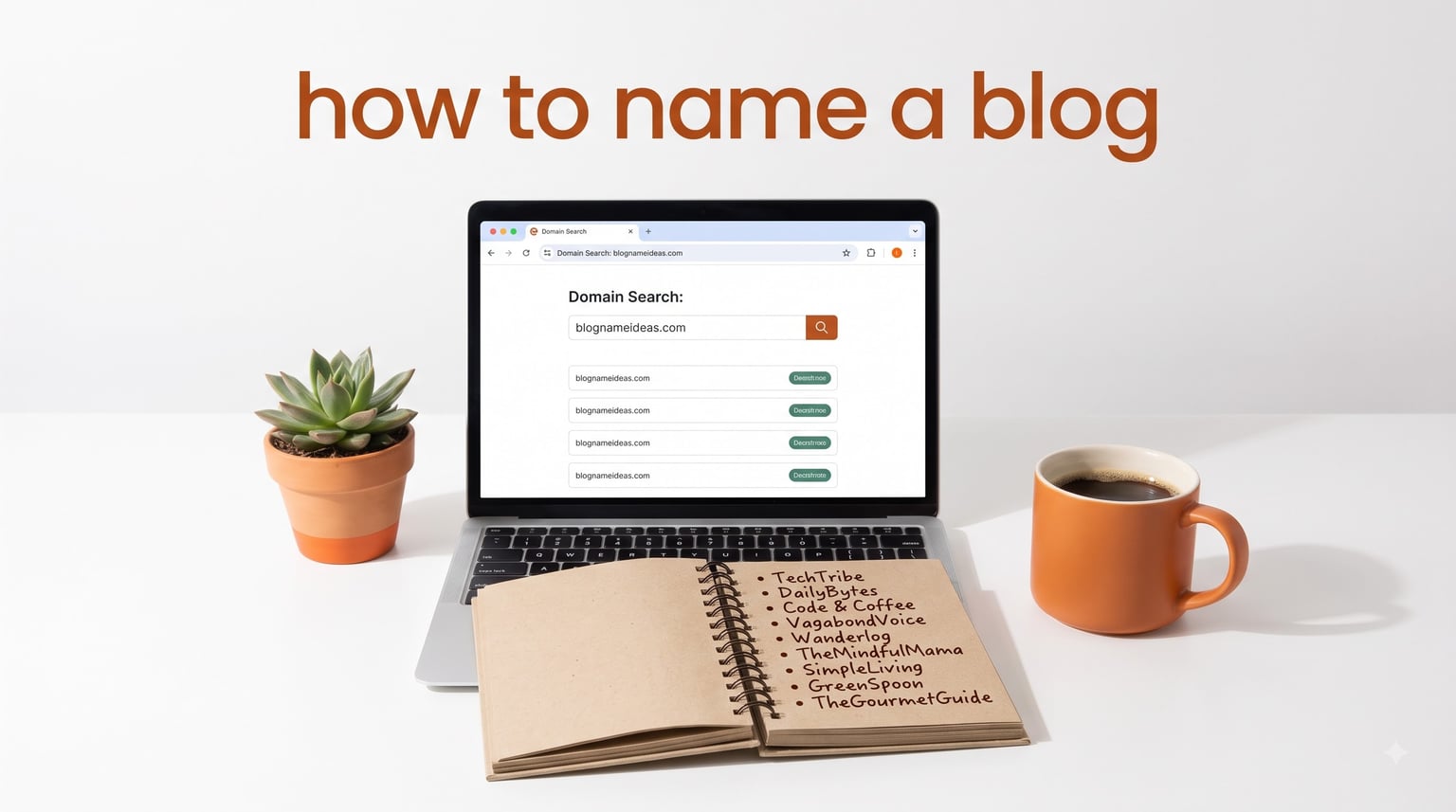
Learning how to name a blog is one of those deceptively simple tasks that stops thousands of new writers before they ever publish a post. I have watched friends sit on a great concept for six months because they could not settle on the right two words. This guide walks you through the exact process I use when naming new projects, and it works whether you are starting a personal blog, a niche review site, or a brand-new media company.
You will get a clear framework for how to name a blog that is memorable, available as a domain, and aligned with your goals. We will cover brainstorming techniques, domain checks, trademark considerations, testing methods, and a final checklist so you stop second-guessing and start publishing.
Table of Contents
Why Your Blog Name Matters More Than You Think
Your blog name is your digital handshake. It shows up in search results, on social media, in your browser tab, and on every link you ever share. A weak name does not kill a blog, but a strong name gives you free advertising for years.
I think of a blog name as three things working together. First, it is a brand that you build recognition around. Second, it is a domain that people type or share. Third, it is a promise to readers about what kind of content lives there. When all three align, you compound your marketing instead of fighting it.
The cost of getting it wrong is real. Rebrands cost time, lose backlinks, confuse returning readers, and force you to update every bio, profile picture, and email signature. Picking the right name up front is far easier than rebuilding one later. That is why a clear process for how to name a blog is worth more than ten brainstorming sessions on a coffee shop napkin.
Define Your Blog Niche and Audience First
Before you brainstorm a single word, narrow your scope. A blog name that tries to be everything ends up meaning nothing. The clearer your niche, the easier your name becomes.
Write down three things in plain language. What topic will you cover. Who is the ideal reader. What is the one problem you help them solve. If you cannot answer those in a paragraph, you are not ready to name the blog. Step back and finish this exercise first.
For example, a blog called “Weekend Baker” signals a specific audience and tone immediately. A blog called “My Thoughts” could be anything, which means it is nothing. Specific names are easier to remember and easier to rank in search engines because they tell Google what you cover.
Forum users on r/Blogging echo this constantly. The most common piece of advice from experienced bloggers is to pick a niche you can write about for two years without running out of material. Your blog name should make that niche obvious.
Brainstorming Techniques That Actually Work
Once your niche is locked, you have a target. Every brainstorming technique below gives you a different angle. I recommend running each method for at least 10 minutes before judging your results. Great blog names rarely show up in the first five tries.
Use a Thesaurus to Expand Your Vocabulary
Open a thesaurus and look up the three or four core words from your niche. Write down every synonym, adjective, and related term. The word “food” might lead you to “fare,” “table,” “feast,” “kitchen,” or “harvest.” Each one opens a new naming lane.
Try Alliteration and Rhyming Patterns
Alliteration means repeating the same initial sound, like “Travel Tribe” or “Fitness Frontier.” It rolls off the tongue and is easier to remember. Brainstorm by pairing your niche word with another word that starts with the same letter. Keep the pair short, ideally two words or three syllables total.
Blend Two Words Into a Portmanteau
A portmanteau is a made-up word that fuses two real words, like “breakfast” (break + fast) or “blog” (web + log). For your blog, try combining your niche word with a feeling word. A travel blog might become “Wanderlustful” or “Roamly.” A fitness blog might become “Liftlife” or “SweatSync.” Portmanteaus are memorable because they sound familiar but feel fresh.
Use a Focus Keyword From Search
Open a search engine and type the main topic of your blog. Look at the autocomplete suggestions and related searches. These are the phrases real people search for. If “budget travel tips” is a high-volume phrase and your blog covers it, a name like “BudgetVoyager” does double duty as branding and SEO.
Borrow From Other Languages
Words from other languages can add flavor and uniqueness. The travel blog “Ciao Bella” feels Italian without explaining it. Just make sure the meaning is appropriate and easy for English speakers to pronounce. A name no one can say out loud is a name no one will recommend.
Combine Random Words With Your Niche
Pick three random nouns from a dictionary page and try stitching them to your niche. The weirdness sparks ideas you would never reach with linear thinking. I once combined “bluebird” and “kitchen” to get a list of warm, creative food blog names that broke me out of obvious patterns.
Use Your Own Name
If you are building a personal brand as a writer, photographer, chef, or creator, using your real name is often the strongest choice. We will cover when this works and when it does not in the next section.
Should You Use Your Own Name for Your Blog?
Using your real name is a real option with real trade-offs. It is the right move in some cases and a mistake in others. The honest answer depends on your goals, your privacy preferences, and your long-term plans.
When Your Own Name Works Well
If you want to be known as a thought leader, speaker, or published author, your own name builds authority that compounds over time. Writers like James Clear and Darren Rowse became household names partly because their blogs carried their identities. Readers remember people more easily than they remember clever wordplay.
Own-name blogs also remove the headache of trademark checks against other bloggers. Your name is, by definition, yours.
When You Should Skip Your Own Name
If you care about privacy, want to keep your day job, or plan to sell the blog someday, your own name can be a liability. Selling a blog built around “Jane Smith Writes” is harder than selling “DailyDrafts.com.” Buyers want portable assets, not personal brands tied to one person.
You also lock yourself into one niche. A personal blog about photography is harder to expand into cooking. A niche-driven name like “ShutterSpoon” lets you pivot without rebuilding the brand.
Privacy Considerations
If you decide to use your name, decide how visible you want to be. Some bloggers use a pen name or middle name to maintain a layer of privacy. Others use their full name and accept the visibility as part of the work. Neither choice is wrong, but make it consciously.
How to Check Domain Availability and Social Handles
Once you have a shortlist of 5 to 10 names, the next step in how to name a blog is making sure you can actually own the name. A brilliant blog name means nothing if the .com is taken and every social handle belongs to someone else.
Step 1: Run the Domain Search
Visit a domain registrar like Namecheap, GoDaddy, or Cloudflare Registrar. Type each candidate name into the search bar. Look for the .com extension first because it carries the most trust and memorability. If the .com is gone but the .co, .net, or .blog is available, weigh whether the alternative still works for you.
Also check whether the taken .com is parked, active, or squatted. A parked page is recoverable through negotiation. An active business site is almost always off-limits.
Step 2: Verify the Brand Across Social Platforms
Search the name on Instagram, TikTok, YouTube, X, Facebook, Pinterest, and Substack. You want a handle that is either completely available or held by an inactive account that you can potentially reclaim later. Consistency across platforms matters more than any single perfect handle.
Tools like Namechk or KnowEm let you check dozens of platforms at once. Run your full shortlist through them in five minutes and you will save hours of manual searching.
Step 3: Decide What to Do If the Name Is Taken
If your dream name is unavailable, you have three real options. First, tweak it slightly with a prefix or suffix like “The,” “Get,” or “HQ.” Second, try a different top-level domain like .co or .blog. Third, let it go and pick the next name on your shortlist.
I lean toward option three. Forcing a name that is already taken usually creates a brand that fights against existing search results and social noise. A clean name with an available .com is almost always worth the trade-off.
Step 4: Register the Domain Immediately
The moment you find a name you love with a clean .com and available social handles, buy the domain. Even if you are not ready to launch, registering it protects your work. Domains cost less than a coffee, and a lost domain costs you weeks of rebranding.
Test Your Blog Name Before You Commit
A name that looks great on paper can fall apart in real life. Testing is non-negotiable in the process of how to name a blog. Run each candidate through the tests below before you buy anything.
The Read-Aloud Test
Say the name out loud five times. If you stumble on a syllable, hesitate, or feel embarrassed saying it to a stranger, drop it. Names that trip your tongue will trip everyone else’s.
The Phone Test
Tell the name to someone over the phone without spelling it. If they can repeat it back correctly, the name passes. If they ask you to spell it three times, the name is too complex.
The Memorize Test
Tell five friends the name once. Wait 10 minutes, then ask them what it was called. If at least three remember it, the name is sticky. If they all forgot, the name is forgettable.
The Search Test
Type the name into Google with quotes around it. Look at what shows up. If the top results are clean and unrelated to your topic, you have a name with room to grow. If the results are dominated by an existing brand, podcast, or product, choose something else.
The Trademark Test
Search the USPTO trademark database at USPTO.gov for your candidate name. If a live trademark exists in a related category, do not use the name. Even if the .com is available, the trademark owner can force you to give up the domain and rebrand.
The Five-Year Test
Imagine yourself five years from now. You have published 500 posts, grown an email list to 10,000 readers, and built a small business around this blog. Does the name still fit. If you wince at the thought, the name does not have legs. Pick something that grows with you.
Common Mistakes to Avoid When Naming a Blog
Most bad blog names fail for the same handful of reasons. Avoid these patterns and you will already be ahead of 80 percent of new bloggers.
Hard-to-Spell Words
If your readers cannot spell your name, they cannot find you. “Quiche” might be a clever pun, but every reader searching for you will end up at Wikipedia. Choose spellability over cleverness every time.
Hyphens and Numbers
Hyphens and numbers make a domain harder to share verbally. “Best-Blog-4-You.com” looks like spam. It reads like spam. Do not use hyphens or numbers in your blog name unless they are essential to the meaning.
Names That Are Too Broad
“Daily Life” or “Random Thoughts” covers everything and promises nothing. Broad names feel safe in the moment and suffocating three months later. Narrow beats broad every time.
Trademark Conflicts
Do not use a name that is trademarked in your niche, even if the .com is technically available. The risk of being forced to rebrand is not worth the small win of a clever name.
Names That Lock You Into One Niche Too Tightly
If you write only about “Keto Desserts” today, you cannot easily pivot to “Healthy Snacks” tomorrow. Keep the name just narrow enough to be clear and just broad enough to grow. This balance is one of the trickier parts of how to name a blog.
Choosing a Name You Are Not Proud Of
If you wince every time you say the name out loud, your readers will feel it too. Your blog name is something you will repeat thousands of times. Pick one that you actually enjoy saying.
Blog Name Generators Worth Trying in 2026
Blog name generators are useful as a starting point, but they are not a substitute for your own thinking. Use them to spark ideas, then apply the brainstorming techniques above to refine the output.
Why Generators Help
They combine words you would not have paired yourself. They save time when you are staring at a blank page. They expose naming patterns you might have missed. Treat them as a creative partner, not an oracle.
Popular Tools
Domain.com’s Blog Name Generator is one of the most popular free tools. Wix has a generator built into its setup flow. Namecheap’s Beast Mode generator checks domain availability in real time. Others worth trying include Hostinger’s AI Generator and the Panabee blog name tool. Each gives slightly different results based on the inputs you provide.
Why Generators Are Not Enough
Generators do not know your audience, your tone, or your long-term goals. They also tend to recycle the same suffixes like “HQ,” “Lab,” “Hub,” and “Daily.” A generator might suggest 50 names, but only a handful will survive the testing process from earlier in this guide.
Use generators to fill your shortlist. Apply the tests. Pick the winner yourself.
Your Final Blog Name Checklist
Before you register the domain and announce your blog, run through this final checklist. If you can answer yes to every question, you are ready to commit.
- Does it clearly signal your niche or topic in two seconds or less.
- Is the .com domain available, or are you choosing an alternative TLD with intention.
- Are the matching social handles available on the platforms you actually plan to use.
- Can you say it out loud without stumbling, and can a stranger repeat it back to you.
- Is it easy to spell without explanation.
- Does it pass the trademark search at USPTO.gov.
- Will it still feel right in five years if your blog pivots or grows.
- Are you proud to say it out loud to your friends and family.
- Does it avoid hyphens, numbers, and confusing characters.
- Have you gotten at least one piece of feedback from a real person before committing.
If even one answer is no, keep looking. The right name is out there, and the discipline to wait for it is what separates blogs that last from blogs that get abandoned after three posts.
Frequently Asked Questions
What makes a good blog name?
A good blog name is short, easy to spell, easy to say out loud, and clearly signals your niche or topic. It should also have an available .com domain and matching social handles so readers can find and share you without friction.
How do I check if a blog name is taken?
Run the name through a domain registrar like Namecheap or GoDaddy to check the .com. Then search the same name on Instagram, TikTok, YouTube, X, and Facebook to confirm social handles are available. Finally, search the USPTO trademark database at USPTO.gov to make sure the name is not already registered in your category.
Can I use my own name for my blog?
Yes, using your own name works well if you want to build a personal brand as a writer, speaker, or creator. It is not ideal if you value privacy, want to sell the blog later, or plan to pivot to a different niche than the one your name suggests.
Can I change my blog name later?
Yes, you can rebrand a blog at any time, but it is disruptive and expensive. You will lose backlinks, confuse returning readers, and need to update every social profile, email signature, and backlink pointing at you. Choosing the right name up front is far easier than redoing it later.
How important is the blog name for SEO?
A blog name alone will not make or break your SEO, but a niche-relevant name gives you a small advantage because it signals your topic to search engines. Quality content, backlinks, and consistent publishing matter far more than the words in your title.
Conclusion
You have a complete process for how to name a blog without spending months stuck in indecision. Define your niche, run the brainstorming techniques, check domains and social handles, test your finalists, and run the final checklist. Then register the name and start publishing.
The right blog name is the one you commit to and build. Pick the best name on your shortlist today, register the .com, and move on to the work that actually matters: writing posts your readers love. Every week you delay is a week your readers never get to meet you.