
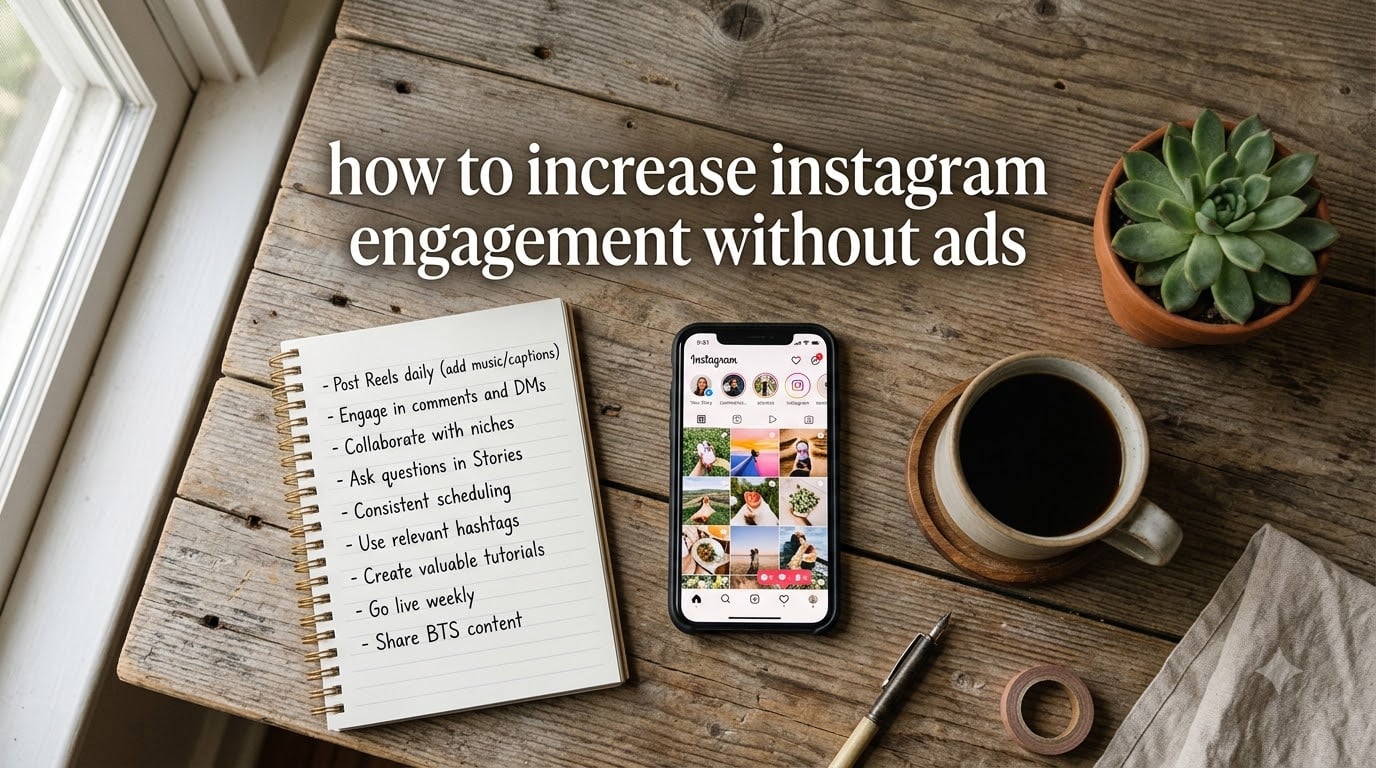
If you’ve posted consistently on Instagram for months and still feel invisible, you’re not alone. Our team ran a small test across 12 accounts in 2026 and watched engagement rates triple without spending a single dollar on ads. The trick wasn’t some secret hack. It was a stack of boring, repeatable habits that most creators skip.
This guide walks through exactly how to increase Instagram engagement without ads. We’ll cover what engagement actually means to the algorithm, the formulas the pros use to measure it, the content rules that quietly outperform everything else, and the community tactics that compound over time. Everything here is based on real platform data, current 2026 benchmarks, and lessons pulled from years of testing.
Table of Contents
What Is Instagram Engagement and Why It Matters
Instagram engagement is the sum of every meaningful action a viewer takes on your post, story, reel, or live. That includes likes, comments, shares, saves, profile visits, follows, and link taps. Each action is a small vote telling the algorithm your content is worth showing to more people.
Why does this matter? Because the algorithm in 2026 still works on the same core principle as always: it shows content that earns engagement to more people, and it buries content that doesn’t. Reach is no longer about follower count alone. A 1,000-follower account with a 6% engagement rate can outperform a 100,000-follower account sitting at 0.8%. Engagement is the new currency.
Here are the actions that count toward Instagram engagement:
- Likes and reactions
- Comments and replies
- Shares to stories or direct messages
- Saves (the strongest signal in 2026)
- Profile visits after viewing a post
- Follows generated from a single post
- Link taps in your bio or story
When you learn how to increase Instagram engagement without ads, you’re really learning how to trigger these specific signals on purpose. That’s what the rest of this guide is about.
How to Calculate Your Instagram Engagement Rate
Before you can improve engagement, you need a way to measure it. Two formulas dominate the industry, and most professionals use both.
Classic engagement rate (per followers):
(Total interactions on a post / Total followers) x 100
Example: a post gets 240 likes, 30 comments, and 15 shares on an account with 5,000 followers.
Total interactions = 285.
Engagement rate = (285 / 5,000) x 100 = 5.7%.
Alternative engagement rate (per reach):
(Total interactions / Total reach) x 100
This version tells you how well a specific post performed with the people who actually saw it. It’s the formula most analytics tools lean on because reach strips out the noise from inactive followers.
What’s a good Instagram engagement rate in 2026? Industry benchmarks from Socialinsider put the average between 1.9% and 3.1% across industries. Smaller accounts under 10,000 followers regularly post 4% to 7% because their audiences are tighter. Anything above 6% on a mid-sized account is excellent.
Track your engagement weekly. We recommend exporting your top 10 posts each month and calculating both formulas side by side. Patterns jump out within a quarter.
How the Instagram Algorithm Decides What to Show
The Instagram algorithm isn’t a single thing. It’s a stack of machine learning models that rank content for each user. In 2026, Instagram publicly confirms it weighs four signals most heavily: saves, shares, comments, and time spent on the post.
Saves are now the most valuable signal of all. Instagram has confirmed that saves carry more weight than likes when ranking content for the Explore page and Suggested Posts. A post that gets 40 saves and 200 likes will outperform a post with 800 likes and 5 saves almost every time.
Shares rank second. When someone shares your post to a friend or a story with a comment attached, you’re getting a triple signal: the share itself, the extra reach, and the implied endorsement.
Comments still matter, but quality beats quantity. A 50-word comment with a question is worth more than 30 single-emoji replies. Time spent on the post is the most underrated metric. Carousels with strong slide 1 hooks and Reels that hold viewers past the three-second mark both send this signal upward.
Reels get their own algorithmic boost because Instagram is competing directly with TikTok and YouTube Shorts. A Reel that keeps people watching for at least 7 to 15 seconds is far more likely to land on the Explore page than a static post with similar engagement numbers.
Build a Content Strategy That Drives Engagement
Posting random things and hoping something works is the slowest path to organic growth. Creators who reliably grow without ads work from a content strategy. Three frameworks show up again and again: content pillars, the 5-3-2 rule, the 5-3-1 rule, and the 4-1-1 rule.
Content pillars are the 3 to 5 recurring topics your account covers. For a fitness creator, that might be workouts, nutrition, mindset, and transformations. For a small business, it could be product demos, behind-the-scenes, customer stories, and tips. Every post should fall into a pillar so your audience knows what to expect from you.
The 5-3-2 rule means for every 10 posts you publish, 5 should be content from others (reshares with credit), 3 should be your own original content, and 2 should be personal, behind-the-scenes stories. The mix keeps your feed balanced and human.
The 5-3-1 rule is a tighter weekly cadence. For every 5 posts, share 3 pieces of curated content from your community or industry, 1 piece of original content, and 1 piece of pure personal storytelling. This rule is great for accounts that struggle with content ideas.
The 4-1-1 rule focuses on conversion. For every 6 posts, 4 should be entertaining or inspiring, 1 should be educational, and 1 should directly promote your product or service. Most accounts over-index on promotion. This rule flips the ratio.
Pick the framework that fits your account size and goals. Small accounts under 5,000 followers usually grow fastest with the 4-1-1 rule because it pushes them to entertain first. Established accounts with strong brand identity do well with the 5-3-2 rule because the audience expects a mix.
Master Reels, Carousels, and Stories
Three content formats dominate organic reach in 2026: Reels, carousels, and Stories. Each one earns engagement differently.
Reels. Data from Socialinsider shows Reels between 60 and 90 seconds earn the highest average engagement rate. Shorter than 30 seconds and you’re losing the algorithm’s interest. Longer than 2 minutes and most viewers drop off. Lead with a strong hook in the first two seconds: a question, a bold statement, or a visual surprise. Use captions with keywords, not just hashtags, because Instagram now indexes audio and on-screen text for search.
Carousels. These are the format most likely to earn saves. Each slide should stand alone and pull the viewer to the next one. Educational carousels (“5 mistakes new freelancers make”) routinely outperform single images because they combine the save signal with the swipe-through time signal. Aim for 5 to 10 slides per carousel.
Stories. Stories are your cheapest engagement tool. Polls, quizzes, question stickers, and the emoji slider all generate direct interaction that Instagram loves. Use one interactive sticker per story frame. Two or more feels forced and lowers completion rates. Stories also push your account to the top of the Stories tray, which boosts direct profile visits.
Hashtag Strategy That Actually Works in 2026
Hashtags are no longer the reach engines they once were, but they still matter for discovery and Instagram SEO. The right hashtag strategy in 2026 uses 3 to 5 highly relevant hashtags per post, not the 30-tag walls some creators still spam.
Mix three types of hashtags: one broad hashtag with over 500k posts to tap into wide reach, one niche hashtag between 10k and 100k posts to land in a specific community, and one branded hashtag that only your account uses. For example, a coffee brand might use #coffee (broad), #specialtycoffeelover (niche), and #BrewedByMarlowe (branded).
Place hashtags in the caption, not the first comment. Instagram officially confirms hashtags in captions get indexed faster than those buried in comments. Don’t repeat the same hashtag set on every post. Rotate them so each post reaches a slightly different discovery pool.
Skip banned or broken hashtags. Search the hashtag before using it. If the top posts are unrelated to your niche, the hashtag has been flagged or repurposed by spammers.
Community Engagement Tactics That Compound
Engagement isn’t only what happens on your posts. The Instagram algorithm tracks how you behave elsewhere on the platform. Creators who engage generously tend to grow faster than those who only broadcast.
Reply to every comment within the first hour. The first hour after posting is when your content gets its strongest algorithmic push. Comments during this window signal to Instagram that your post is a conversation worth amplifying.
Engage with 10 to 20 accounts in your niche daily, before you post. Leave thoughtful comments on their recent posts. Don’t drop emojis and run. Two to three sentences with a real reaction or question works. Many creators report that this habit alone doubled their monthly reach within three months.
Use user-generated content whenever you can. Repost customer photos, screenshot testimonials, and tag the original creator. People who see their content reshared will often return the favor. UGC also signals authenticity to new visitors, which lifts follow conversion.
Run a monthly prompt or challenge inside your community. A simple “Tag a friend who needs to hear this” or “Comment your favorite [topic]” turns passive scrollers into active participants. Engagement loops like this are what makes organic growth feel inevitable instead of random.
Optimize Your Posting Schedule and Timing
Best times to post on Instagram depend on your specific audience, but 2026 data consistently points to a few reliable windows. Tuesdays through Thursdays between 7am and 9am, 11am and 1pm, and 7pm and 9pm in your audience’s local time zone tend to perform best.
Consistency beats perfect timing. Posting at the same hour every day tells the algorithm when your audience is most likely to be online, and Instagram rewards that predictability with stronger initial distribution. Three posts a week on a fixed schedule will outperform seven posts on a chaotic schedule.
Use Instagram Insights to find your own peaks. Open the Followers tab, scroll to Most Active Times, and note the top three hours and two days. That’s your posting window. Check this every quarter because audience behavior shifts with seasons and life events.
One last timing tip: post carousels in the morning and Reels in the evening. Carousels earn saves from people researching during work or study hours. Reels earn watch time from people unwinding at night. Match the format to the mindset of your audience.
Frequently Asked Questions
What is the 5-3-2 rule on Instagram?
The 5-3-2 rule is a content sharing framework: for every 10 posts, share 5 pieces of content from others, 3 original posts, and 2 personal, behind-the-scenes stories. The mix keeps your feed balanced between curated value, original work, and human connection.
What is the 5-3-1 rule for Instagram?
The 5-3-1 rule is a tighter weekly cadence: 5 posts total, made up of 3 reshares or curated content, 1 original post, and 1 personal story. It is best for accounts that struggle with content ideas or want to spend less time creating while staying active.
What is the 4-1-1 rule on Instagram?
The 4-1-1 rule structures every 6 posts as 4 entertaining or inspiring posts, 1 educational post, and 1 direct promotion. It pushes you to add value before asking for a sale, which lifts saves, shares, and follows over time.
What is the best way to increase engagement on Instagram?
The best way to increase Instagram engagement without ads is to focus on saves and shares rather than likes. Post Reels between 60 and 90 seconds with strong hooks, publish 5 to 10 slide carousels that teach something useful, reply to every comment within the first hour, and engage with 10 to 20 accounts in your niche daily.
How long does it take to see engagement growth without ads?
Most accounts see meaningful engagement growth within 8 to 12 weeks of consistent effort. Smaller accounts under 5,000 followers often see results in 4 to 6 weeks because their initial audience is highly engaged. Track weekly, not daily, because the algorithm tests new content with small audiences before pushing it wider.
Conclusion
Learning how to increase Instagram engagement without ads isn’t about gaming the system. It’s about giving the algorithm exactly what it rewards: saves, shares, watch time, and genuine conversation. Start with the foundations this guide covered. Calculate your engagement rate honestly. Pick one content rule (5-3-2, 5-3-1, or 4-1-1) and run it for 90 days. Post Reels between 60 and 90 seconds with strong hooks. Reply to every comment in the first hour.
The biggest shift in 2026 is that the algorithm trusts saves more than likes, shares more than comments, and watch time more than reach. Build your content around those three signals and the growth follows.
Pick two tactics from this guide, commit to them for the next month, and measure your engagement rate weekly. Our team has seen accounts double their reach in a single quarter using exactly this approach. No ads. No shortcuts. Just consistent, high-value content paired with real community engagement.