
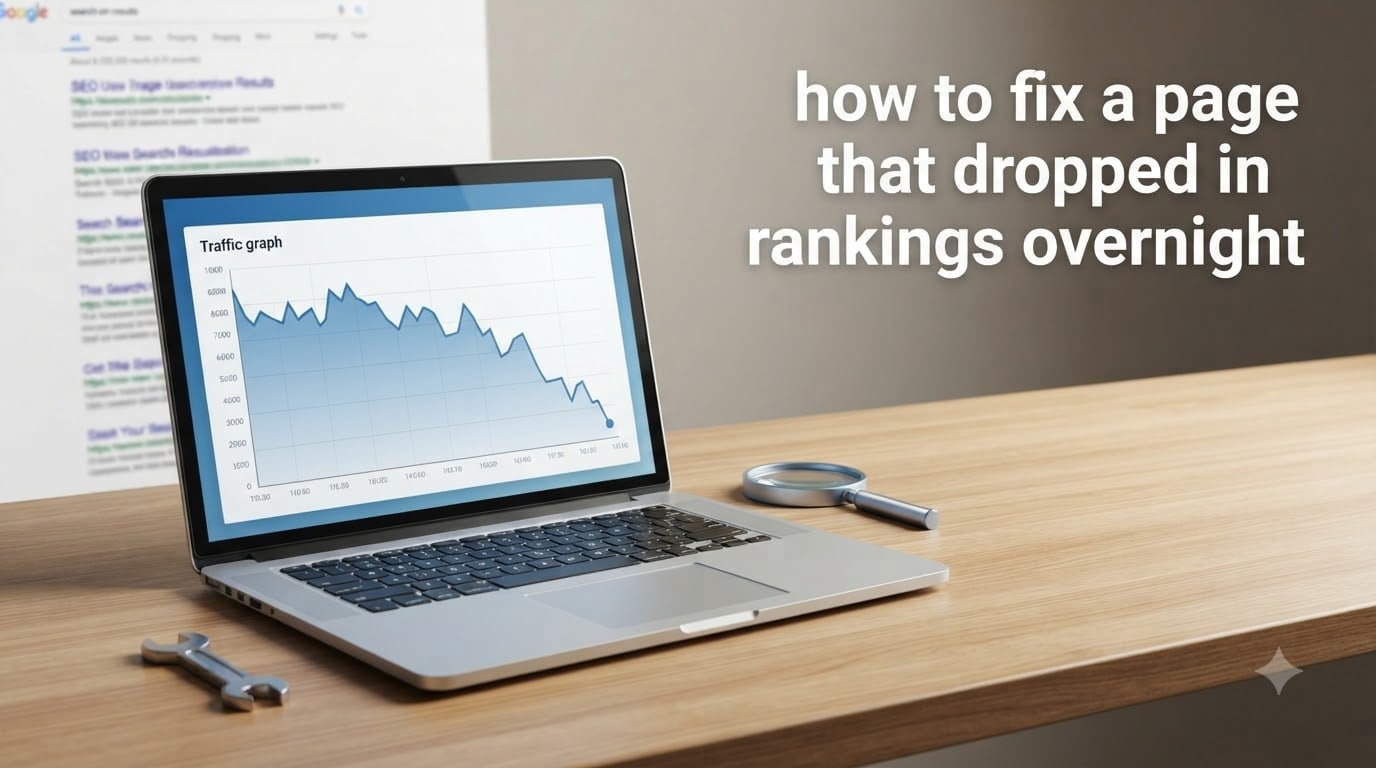
I know the feeling. You wake up, open Search Console, and a page that was sitting comfortably on page one has fallen off the map. Traffic is cut in half, leads have dried up, and your first instinct is to panic-edit something on the site. I have been there, and I have watched dozens of site owners make the same mistakes that turn a recoverable dip into a six-month nightmare.
Here is the truth most SEO articles will not tell you upfront: a sudden ranking drop is almost always diagnosable, usually fixable, and rarely caused by the thing you think caused it. This guide walks you through how to fix a page that dropped in rankings overnight using a diagnostic-first approach. We will start by ruling out the scary stuff, then narrow down the cause, then apply targeted fixes with realistic timelines.
By the end, you will have a clear recovery plan, an honest expectation of how long it takes, and a list of common panic moves to avoid.
Table of Contents
Why Pages Drop in Google Rankings Overnight
An overnight ranking drop is almost never random. Google runs over 4,000 algorithm updates a year, and your site intersects with dozens of them every month. When a page falls sharply, it usually means one of three things changed: Google changed how it evaluates something, your site changed something it should not have, or the competitive landscape shifted beneath you.
According to industry data, roughly 63% of sudden ranking drops are linked to confirmed algorithm updates. The remaining 37% split between technical site issues, lost backlinks, content decay, and manual penalties. That is why we start with diagnosis before any fix, because guessing wastes days you do not have.
What the Data Says About Sudden Drops in 2026
Most affected pages fall between 3 and 12 positions within a 24-hour window. Drops larger than 15 positions almost always correlate with either a broad core update or a manual action. Drops clustered on a single page tend to point at technical or backlink issues specific to that URL.
Common Causes of Sudden Ranking Drops
Before you can fix a page that dropped in rankings overnight, you need to know what you are actually fixing. These seven causes cover the overwhelming majority of cases I see in real audits.
1. A Google Algorithm Update Rolled Out
Core updates, helpful content updates, and spam updates all reassess which pages deserve top positions. If your rankings dropped the same week Google announced a confirmed update, that is your starting hypothesis. You can verify timing against Google’s search status page or trusted trackers.
2. A Site Change You Forgot About
Someone in your team may have pushed a CMS update, changed a robots.txt rule, added a noindex tag, or updated canonical URLs. These changes silently tank rankings within hours. I once watched a client lose 70% of traffic because a developer added a trailing slash redirect that broke 4,000 internal links overnight.
3. You Lost Important Backlinks
Backlink profile changes are a frequent trigger. If a high-authority site deleted your link, removed a guest post, or changed an outbound link, your page can lose ranking signals overnight. Tools like Ahrefs or Semrush will flag lost referring domains within 48 hours.
4. Your Competitors Got Better
Sometimes you did nothing wrong. A competitor published a stronger piece of content, earned more backlinks, or improved their E-E-A-T signals, and Google reassigned the top spots. This is the most demoralizing cause, but it is also the most common in competitive niches.
5. Technical SEO Issues Crept In
Crawl errors, indexing problems, Core Web Vitals regressions, mobile usability flags, and JavaScript rendering failures can all cause sudden drops. Page speed in particular has become a fast-moving ranking factor, and a single poorly optimized image can drag a page below the threshold.
6. Your Content Lost E-E-A-T Signals
E-E-A-T (Experience, Expertise, Authoritativeness, and Trust) is not a direct ranking factor, but it is a framework Google uses to evaluate YMYL topics. If your author bios disappeared, citations went stale, or your about page lost credentials, trust can drop with it.
7. A Manual Penalty Was Applied
Rare, but brutal. A manual action against your site shows up in Search Console under Security and Manual Actions. Common triggers include unnatural links, thin content, cloaking, or user-generated spam. Manual penalties are site-wide or section-wide, not single-page, so the pattern is your clue.
Penalty vs Algorithm Update: How to Tell the Difference
This is the question I get asked most often, and getting it right saves weeks of wasted effort. Here is a quick comparison.
Penalty Signals
A manual penalty will always show a notification in Google Search Console under Security and Manual Actions. Traffic usually falls 80% or more, the drop is consistent across many pages, and you can usually trace it to a recent link building campaign or content change. Recovery requires fixing the issue and submitting a reconsideration request.
Algorithm Update Signals
An algorithm update produces no Search Console notification. The drop is often less severe (30 to 60%), may be concentrated on certain content types, and the timing matches a confirmed Google update. Recovery happens by improving quality signals, not by submitting a request.
The Quick Rule
If Search Console shows a manual action, it is a penalty. If it does not, and your drop timing matches a known update, it is algorithmic. Everything else is technical, content, or links.
How to Diagnose a Ranking Drop: A Step-by-Step Framework
This is the part of the article you will want to bookmark. Follow these seven steps in order, and you will identify the cause within an hour in most cases.
Step 1: Confirm the Drop Is Real
Open Google Search Console and pull the last 90 days of performance for the affected page. Filter by query and compare the last 7 days to the previous 30. A single bad day is volatility. A consistent downward trend is a real drop.
Step 2: Check for Confirmed Google Updates
Cross-reference the date your drop began with Google’s search status announcements. If the dates line up, you are looking at an algorithm update and your recovery path is content and quality improvement.
Step 3: Inspect Search Console for Manual Actions
Go to Security and Manual Actions in Search Console. If anything is listed, stop the diagnostic and read the violation report. Your entire recovery plan changes from this point.
Step 4: Audit the URL in Search Console URL Inspection
Paste the affected URL into the URL Inspection tool. Confirm it is indexed, check the last crawl date, and look for any rendering errors. If Google says it is not indexed, that is your problem.
Step 5: Run a Technical Crawl
Use Screaming Frog, Sitebulb, or a similar crawler to scan your site. Look for 4xx and 5xx errors, redirect chains, noindex tags on the page, broken canonical tags, and Core Web Vitals regressions. Technical issues account for about 25% of sudden drops I diagnose.
Step 6: Compare Backlink Profiles
Open Ahrefs or Semrush and compare your referring domains for the affected page against 30 days ago. Any lost high-authority links are prime suspects. Also check for a spike in spammy links, which can trigger algorithmic demotions.
Step 7: Review Recent Content and Site Changes
Check your CMS, Git history, or team Slack for any changes made in the 14 days before the drop. Look for content edits, template changes, new plugins, or schema updates. Most “mystery” drops turn out to be a forgotten config change.
How to Fix a Page That Dropped in Rankings Overnight
Once your diagnosis points at a cause, the fix follows a predictable path. These recovery steps are ordered from fastest wins to longer-term rebuilds.
Fix 1: Reverse Any Recent Site Changes
If your diagnostic surfaced a recent change, revert it. Undo template updates, fix the robots.txt rule, remove the accidental noindex, restore the old canonical. Expect 3 to 14 days for Google to recrawl and reflect the change.
Fix 2: Resolve Technical Errors
Fix every crawl error, redirect chain, and Core Web Vitals regression on the page. Compress images, defer non-critical JavaScript, and clean up the schema markup. Most technical fixes show impact within 1 to 4 weeks.
Fix 3: Reclaim Lost Backlinks
For each lost backlink, contact the linking site and request restoration. Offer updated content if needed. About 30 to 40% of lost links can be recovered with a polite email. Anything you cannot recover, compensate for with new high-quality links.
Fix 4: Strengthen Content Quality
If you are recovering from a core update, content refresh is your main lever. Add original data, update outdated information, expand thin sections, and improve E-E-A-T signals by updating author bios and adding citations. Expect 3 to 6 months for full core update recovery.
Fix 5: Submit for Reconsideration (Penalties Only)
If your diagnostic confirmed a manual penalty, fix the documented issue, document the cleanup, and submit a reconsideration request through Search Console. Approval typically takes 2 to 4 weeks.
Recovery Timeline by Cause Type
Technical issues usually recover within 1 to 4 weeks. Backlink losses take 4 to 8 weeks to compensate. Core algorithm updates require 3 to 6 months of sustained quality work. Manual penalties take 2 to 4 weeks after reconsideration approval. These are averages, not guarantees, but they are realistic.
What NOT to Do After a Ranking Drop
This is the section most guides skip, and it is the one that prevents the most damage. When traffic falls, your instincts will push you toward moves that make things worse.
Do not rewrite your content from scratch before diagnosing. I have seen site owners delete their best-performing article based on a guess, only to realize the drop was a 48-hour indexing glitch. Do not buy backlinks in a panic. Google’s spam algorithms are specifically designed to catch this. Do not submit your sitemap 50 times hoping for faster indexing. Do not redirect the affected page to another URL. And do not change your entire site structure trying to “reset” something.
The single biggest mistake is making multiple changes at once. If you change five things and your rankings recover, you will not know which one fixed it, and you cannot replicate the success. Fix one variable at a time, measure for at least 7 days, then move on.
How to Prevent Future Overnight Ranking Drops
The best recovery is the one you never need. Set up alerts in Search Console for indexing errors and manual actions. Monitor your backlink profile weekly for sudden losses. Track Core Web Vitals monthly. Run a quarterly technical audit. Keep a change log so every site edit is traceable.
Subscribe to trusted algorithm tracking sources so you know the moment a confirmed update rolls out. The SEO community is loud and chaotic, but a handful of trackers are reliable. Knowing whether a drop was you or Google is half the battle.
Most importantly, build content that earns rankings rather than borrows them. Pages that solve real problems, cite real sources, and demonstrate real expertise are far more resistant to algorithm shifts than pages optimized for loopholes.
Frequently Asked Questions
Why has my website dropped in rankings?
Most overnight ranking drops are caused by one of seven things: a Google algorithm update, a recent site change, lost backlinks, competitor improvements, technical SEO issues, weakened E-E-A-T signals, or a manual penalty. Run a Search Console check first, then cross-reference the drop date with known algorithm updates before assuming the cause.
How to get Google rankings back if your positions dropped?
Recover rankings by first diagnosing the exact cause, then applying the matching fix: revert site changes for technical issues, restore lost backlinks for link drops, refresh content quality for core updates, or submit a reconsideration request for manual penalties. Expect 1 to 4 weeks for technical fixes and 3 to 6 months for algorithm recovery.
What could be causing my sudden drop in Google rankings?
Sudden drops usually trace back to algorithm updates, accidental site changes like a noindex tag or broken redirect, lost high-authority backlinks, Core Web Vitals regressions, or in rare cases a manual penalty. The fastest diagnosis path is Search Console URL Inspection plus a backlink profile comparison over the last 30 days.
Why has my website traffic suddenly dropped?
Website traffic drops mirror ranking drops but can also come from non-SEO causes like seasonality, a tracking code break, or a server outage. Confirm the cause by checking Google Analytics for traffic source breakdowns and comparing organic sessions against the previous 90 days before assuming an SEO issue.
Final Thoughts on Recovering From an Overnight Drop
An overnight ranking drop feels catastrophic, but it is almost always diagnosable within an hour and recoverable within weeks to months. The key is resisting panic, running the seven-step diagnostic framework above, and applying the fix that matches the cause rather than the fix that feels safest.
Use this guide the next time your rankings slip, bookmark the diagnostic steps, and remember that most drops are temporary. If you want to learn more about how to fix a page that dropped in rankings overnight or build a long-term SEO defense plan, keep exploring our SEO resources for the latest recovery playbooks.