
I remember staring at my first competitor’s homepage for two hours, writing nothing down, and closing the tab more confused than when I started. If you are running a small website and trying to figure out how to do a competitor analysis without getting buried in dashboards, you are not alone.
Here is the good news: a solid competitor analysis for a small website does not require a marketing agency, a paid suite, or weeks of your time. It requires a clear process, a few free tools, and the honesty to look at your rivals without copying them. In this guide, I will walk you through the exact steps I use with my own sites and with the small business owners we help at Stay Go Links.
By the end, you will have a simple competitor analysis template you can fill out this week, a list of free tools, and a short FAQ that answers the most common questions small website owners ask.
Table of Contents
What Is Competitor Analysis and Why Small Websites Need It
Competitor analysis is the process of identifying the other websites and businesses competing for the same audience as you, then studying their strategies, strengths, and weaknesses so you can make smarter decisions about your own site. It covers SEO, content, design, pricing, social media, and the overall value proposition.
You might think this is only for big brands with research budgets. In my experience, the opposite is true: small websites gain more from competitor analysis because every insight translates directly into quicker wins. A small site that knows where competitors rank, what content they publish, and how they engage readers can leapfrog bigger players by simply doing the basics better.
Why small websites specifically benefit
Larger companies have teams and budgets to absorb bad calls. Smaller websites cannot afford that luxury, so a short, regular competitor check keeps strategy grounded in what the market actually rewards. I have watched small sites double organic traffic in six months just by analyzing two or three rivals and writing better versions of the same topics.
Competitor analysis also exposes gaps. Most industries have a handful of questions, keywords, or customer pain points that nobody on page one is answering well. Finding those gaps is the single fastest growth lever a small website has.
How to Do a Competitor Analysis for a Small Website: 7 Proven Steps
This is the core process I use every quarter on my own projects. It is built for one person, takes about three to four hours the first time, and gets faster on every repeat run. Treat it as a living system, not a one-off project.
Step 1: Identify Your Direct and Indirect Competitors
Start by listing the websites you already know compete for your audience. Open Google, type in your main keyword, and write down the top five organic results. Those are your direct competitors.
Then think about indirect competitors. These are sites solving the same problem in a different way, or targeting the same buyer in a different niche. A coffee shop and a tea subscription box may be indirect competitors for “morning drinks.” Write those down too. Most small site owners forget this step and miss out on creative inspiration from outside their immediate niche.
Step 2: Gather Basic Information About Each Competitor
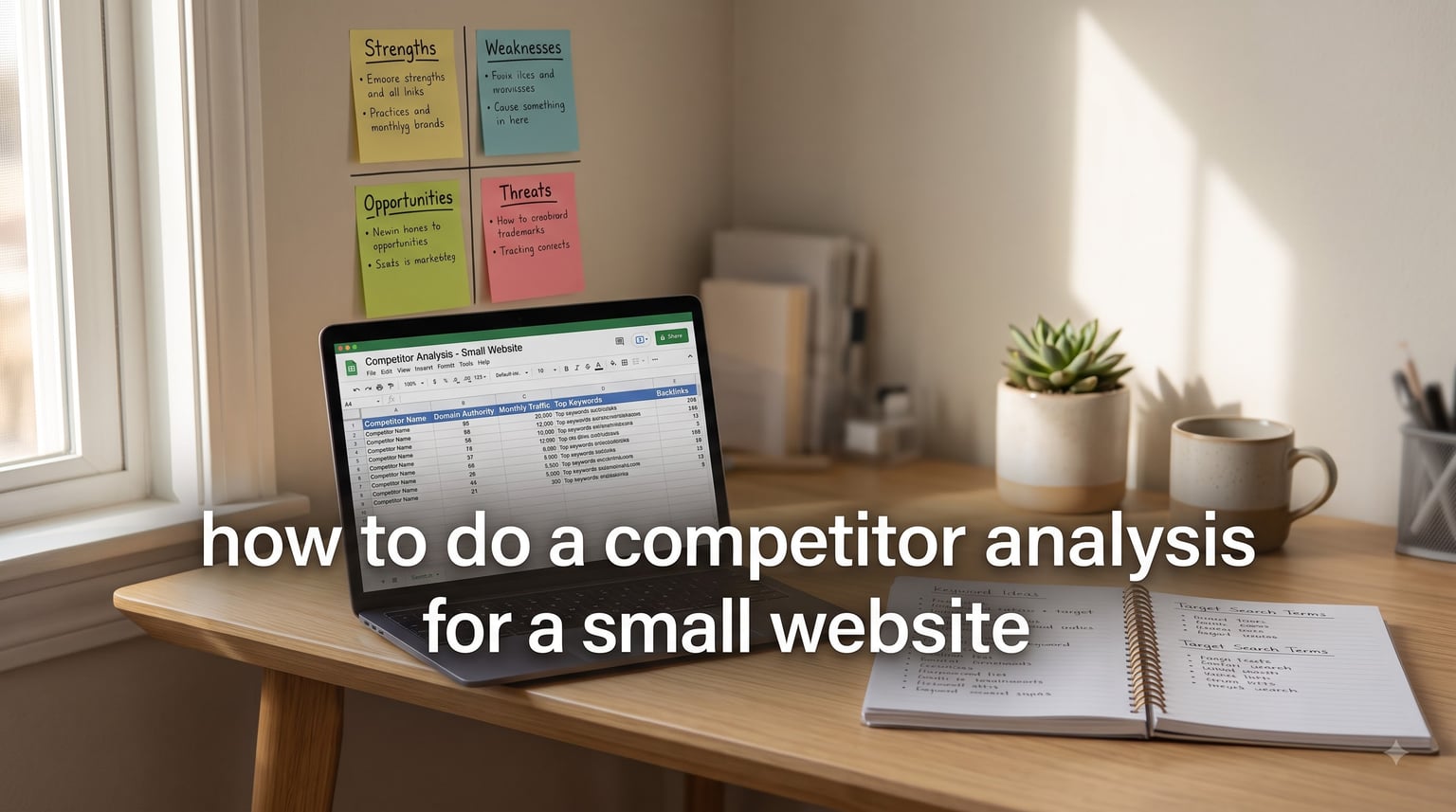
For each competitor, capture the basics in a single spreadsheet. I keep columns for URL, year founded, target audience, main products or topics, estimated traffic, and a one-line summary of how they position themselves. This snapshot becomes your reference document for everything that follows.
Keep it boring and simple. You are not writing a business school case study; you are giving yourself a clear picture of who is in your lane.
Step 3: Analyze SEO and Keyword Performance
Next, look at how each competitor wins traffic. The key areas are the keywords they rank for, their backlink profile, and their on-page SEO. You do not need every metric, just enough to see patterns.
I always start with the keywords they rank for in the top 10. Look for two things: keywords I should also target, and keywords I have a realistic chance of beating them on. Long-tail keywords with low authority competitors are your fastest wins as a small website.
Step 4: Audit Content Strategy and Marketing Tactics
Read the last 10 posts or pages each competitor published. Note the topic, format (guide, list, video, case study), word count, and any hook that made the content stand out. Patterns will jump out within an hour.
Pay attention to their email capture, lead magnets, calls to action, and social media presence. Where do they send traffic? What offers convert visitors into subscribers? These clues shape your own content strategy without forcing you to invent from scratch.
Step 5: Run a SWOT Analysis
SWOT stands for Strengths, Weaknesses, Opportunities, and Threats. For each competitor, fill in the four quadrants honestly. Strengths and weaknesses are internal to the competitor; opportunities and threats come from how you can outperform them.
A simple SWOT makes it easy to see where your site has a real edge and where you need to step up. I keep mine on a single page and review it every quarter. You will be surprised how quickly patterns emerge when you see them side by side.
Step 6: Compare Pricing, Features, and Value Propositions
If your small website sells a product or service, this step is critical. Map each competitor’s pricing tiers, features included, and how they phrase the value they deliver. The phrase matters as much as the price.
Look for mismatches between what the competitor promises and what they actually deliver. Those gaps are where you can position yourself more clearly. Customers consistently choose the brand that names their pain point best, not the one with the longest feature list.
Step 7: Turn Insights Into Action
The final step is the one most people skip. Take your notes and turn them into three to five concrete actions for the next 30 days. Examples: write a better version of competitor article X, target keyword Y you noticed they missed, test a lead magnet modeled after competitor Z.
Set a calendar reminder to repeat the process in 90 days. Consistency beats intensity. A short, regular competitor check compounds in a way an annual project never can.
What to Analyze on a Competitor Website (Checklist)
This is the same checklist I keep pinned above my desk. It covers the four layers that drive traffic and conversions for small websites.
- SEO factors: Title tags, meta descriptions, header structure, internal links, page speed, mobile responsiveness, backlink sources.
- Content factors: Topic clusters, publishing frequency, content depth, hook in the first 100 words, use of visuals, call to action style.
- Design and UX factors: Navigation clarity, whitespace, above-the-fold message, signup form placement, accessibility basics.
- Marketing and social factors: Email opt-in offer, social channels used, posting cadence, community engagement, partnerships and mentions.
Run through this checklist for every competitor at least once. Most small site owners find two or three improvements they can apply to their own site the same day.
Free Tools for Competitor Analysis on a Budget
You do not need paid software to do a serious competitor analysis. These free tools cover 90 percent of what small websites actually use.
Free SEO tools
- Google Search Console: See exactly which keywords bring you clicks and which competitor pages outrank you.
- Google Analytics: Compare traffic sources and pages, and benchmark against competitor traffic estimates.
- Ubersuggest free tier: Get a quick view of competitor keywords, top pages, and backlink counts.
Free traffic and content tools
- SimilarWeb free version: Rough estimates of competitor traffic sources and audience overlap.
- AnswerThePublic: Reveals questions your competitors may have missed.
- Archive.org (Wayback Machine): See how competitor sites evolved and what they changed.
Free monitoring tools
- Google Alerts: Get an email every time a competitor is mentioned online.
- Social listening on X and LinkedIn: Free searches by competitor name show their engagement patterns.
- A simple spreadsheet: Your central competitor analysis template. No software beats a clean table you control.
Set up Google Alerts in under five minutes. The first email you get about a rival’s new product or article usually sparks your next content idea.
Using ChatGPT and AI for Faster Competitor Analysis
AI tools like ChatGPT can speed up competitor research, but only if you use them with good inputs. Treat the AI like a research assistant, not an oracle.
AI prompts for competitor research
- “Based on this competitor’s homepage, list their target audience, value proposition, and main calls to action.”
- “Summarize the top 10 themes in this competitor’s blog and group them into content pillars.”
- “Compare the strengths and weaknesses of these three competitors and suggest differentiation angles for my small website.”
Limitations of AI analysis
AI cannot see live Google results, real traffic data, or current backlink profiles. Use it for synthesis, not for fresh data gathering. Always verify AI summaries against the actual site so you do not publish insights based on invented features or prices.
When I use ChatGPT for competitor analysis, I paste the competitor’s “About” page, a few recent blog posts, and the FAQ. From that I get a quick first draft of positioning and messaging angles, which I then tighten with my own judgment.
Common Mistakes Small Websites Make in Competitor Analysis
Most small site owners fall into the same handful of traps. Knowing them upfront saves you months of wasted effort.
Copying instead of differentiating
If your competitor strategy ends with “do exactly what they do,” you will always be one step behind. The goal of analysis is to find angles your rivals missed, not to become a clone.
Analysis paralysis
It is easy to spend weeks collecting data and never changing anything. I made this mistake on my first site. Pick your three to five actions and ship them this month. You can always run another round later.
Forgetting indirect competitors
Indirect competitors often teach you more than direct ones because they solved the same problem from a fresh angle. Include them in your shortlist every time.
Frequently Asked Questions
How to analyse a competitor website?
Start by listing the top three to five organic Google results for your main keyword. Then audit each site across four layers: SEO (keywords, backlinks, page speed), content (topics, formats, publishing cadence), design and UX (navigation, signup flow), and marketing (email opt-in, social presence). Capture everything in a single spreadsheet and review it every quarter. Most small website owners can complete a useful analysis in three to four hours using free tools.
How do I create a competitor analysis?
Begin with a simple template that includes columns for URL, target audience, main topics, top keywords, content cadence, pricing, and a SWOT summary. Start by identifying three direct and two indirect competitors, then fill the template using free tools like Google Search Console, Ubersuggest, and SimilarWeb. Close each section with two or three actions you can take on your own site in the next 30 days.
How to use ChatGPT for competitor analysis?
Paste competitor homepages, About pages, and recent blog posts into ChatGPT, then ask targeted prompts such as listing the value proposition, grouping themes into content pillars, or comparing strengths and weaknesses. Use the AI output as a draft you verify against the live site, since ChatGPT cannot access current search or traffic data on its own.
What are the 5 steps of a competitive analysis?
A practical five-step process for small websites is: (1) identify your direct and indirect competitors, (2) gather the basics about each in a spreadsheet, (3) analyze their SEO and keywords, (4) run a SWOT analysis, and (5) turn the insights into three to five concrete actions within 30 days. Repeating this cycle quarterly turns competitor analysis into a habit instead of a project.
Final Thoughts: Your First Competitor Analysis This Week
Learning how to do a competitor analysis for a small website is less about tools and more about building a habit. Pick three rivals, open a blank spreadsheet, and spend one focused afternoon filling it out using the steps above. By the end of the week you will know more about your market than most small site owners figure out in a year.
Run the same exercise again in 90 days. The small website that compounds these insights beats the one that studies competitors once and never revisits the work.