
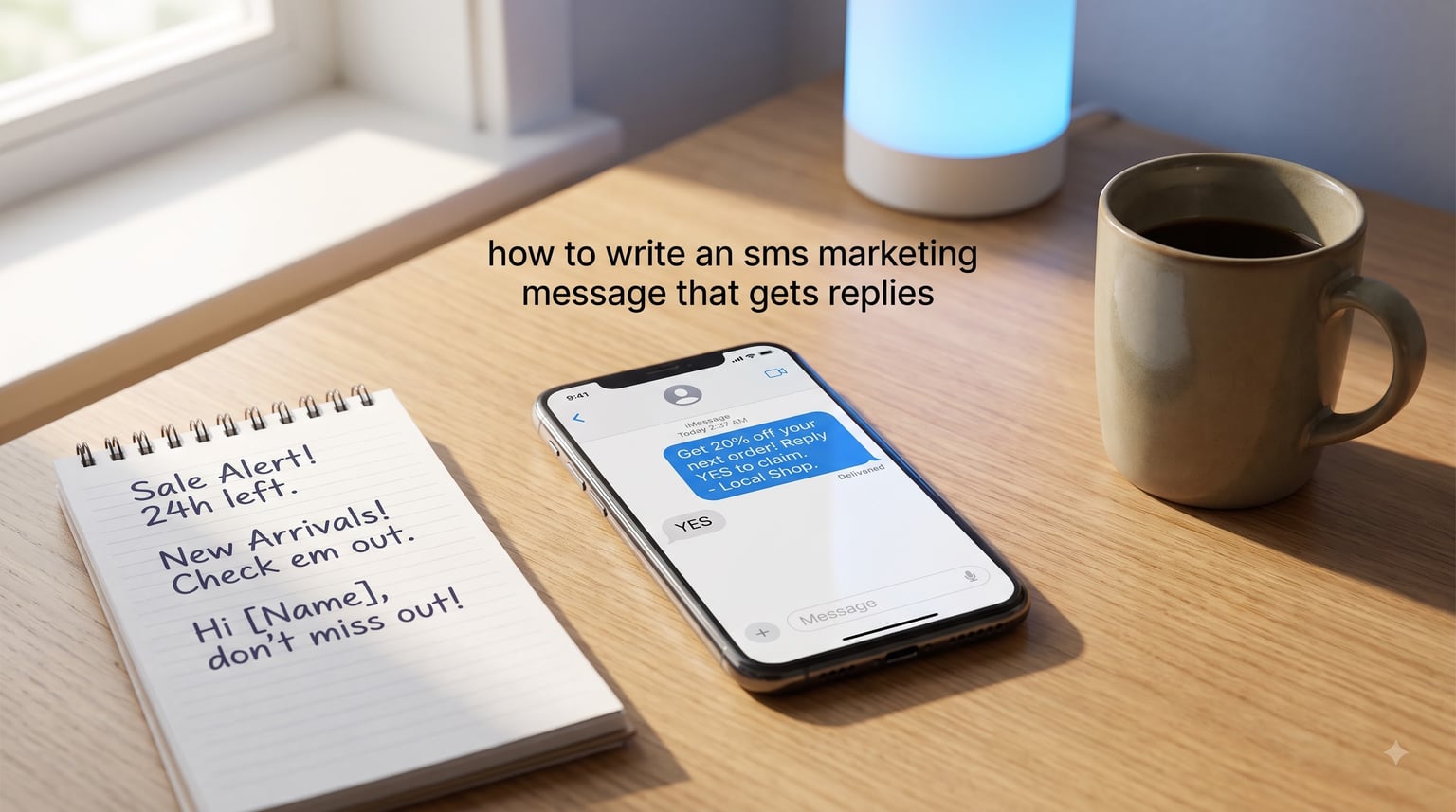
If you want to know how to write an SMS marketing message that gets replies, the answer is simpler than most guides make it: lead with value, talk like a human, and end with one easy ask. I’ve spent the last few years sending and reviewing thousands of marketing text messages for ecommerce stores, B2B sales teams, and local service businesses, and the messages that actually get replies follow a tight pattern.
This guide pulls together everything I’ve learned. You’ll get the exact framework I use, 10 ready-to-copy templates, and the timing, compliance, and measurement rules that keep reply rates high. No fluff, no padding – just the writing playbook that works in 2026.
Table of Contents
What Makes an SMS Marketing Message Get Replies
SMS marketing messages that get replies share three traits: they feel personal, they offer something the recipient actually wants, and they make replying easier than ignoring. SMS already has a built-in advantage – 98% open rate and 45% response rate compared to email’s 20% open and 6% response – but most brands waste that edge by writing texts that sound like billboards.
The reply gap comes down to how the message is written. A text that opens with “Hi Sarah, your size is back in stock” reads completely differently from “BIG SALE 50% OFF EVERYTHING TODAY ONLY.” One invites a response, the other invites an opt-out.
Here are the eight traits I look for in every message that hits my “replies” list:
- Opens with the recipient’s name or a behavior-based hook
- Stays under 160 characters when possible
- Leads with value, not the brand name
- Uses one clear call-to-action
- Reads like a person, not a marketing department
- Includes timing when urgency matters
- Makes replying easier than ignoring
- Follows with an opt-out option
Every section below covers one of these traits in detail, with examples you can copy.
The 160-Character Rule: Why Brevity Wins
SMS marketing messages have a hard ceiling at 160 characters. Go over that and your message splits into multiple parts, costs more to send, and reads like spam. Sticking to 160 characters forces you to be clear, which is exactly what drives replies.
Most of the messages that get replies I send are between 120 and 160 characters. The shorter end works for appointment reminders and quick alerts. The longer end works for promotional offers with a clear CTA. Anything past 160 characters needs a real reason.
How to Cut a Message to 160 Characters
Start by removing anything that doesn’t serve the recipient. Cut filler words like “just,” “really,” and “actually.” Replace full brand names with the shorter version your audience already calls you. Drop greetings and sign-offs – they waste characters that could go toward your offer.
Before you send, count your characters. I keep a character counter open when writing SMS copy. The 30 seconds it takes to check saves the embarrassment of a message splitting awkwardly on someone’s phone.
When Going Over 160 Characters Is Worth It
Two cases justify longer messages. The first is compliance – you must include opt-out language. The second is complex offers where a single short sentence would mislead the reader. In both cases, split the message so the value and CTA land in the first 160 characters, and put the legal or detail text after.
How to Personalize SMS Messages That Convert
Personalization is the single biggest driver of SMS reply rates. A message with a first name and one behavior-based detail can double reply rates compared to a generic blast. Generic messages get ignored. Personal messages get answered.
The trick is using real data you already have. Every ESP, CRM, and SMS platform lets you pull in merge tags for first name, last name, location, and past purchases. Use them, but use them right.
Three Levels of Personalization
Level one is name personalization. Drop the recipient’s first name into the first line. “Hi Sarah” reads warmer than “Hi there,” and it takes zero extra work because your SMS tool handles it automatically.
Level two is behavior personalization. Reference something the recipient actually did – browsed a product, abandoned a cart, signed up for a demo, attended a webinar. “Your yoga mat is back in stock” beats “Check out our sale” every time.
Level three is segment personalization. Group your audience by stage in the lifecycle (new subscriber, repeat buyer, VIP, lapsed customer) and write a message that speaks to where they are. A lapsed-customer text needs a win-back offer, not a product launch announcement.
Combine levels when you can. “Hi Marcus – your saved trail running shoes are back, and your size is in stock” hits all three levels in one sentence.
Lead With Value in the First 10 Words
People decide whether to read or delete a text in the first two seconds. That means the first 10 words carry the whole message. If the value isn’t obvious in the opening line, the message dies there.
The first 10 words should answer the reader’s silent question: “Why should I care?” Skip the brand intro, skip the “We wanted to let you know,” and go straight to the benefit.
Examples of Strong Openings
- “Your order ships today, here’s the tracking”
- “Your 20% off code expires in 3 hours”
- “Your appointment is tomorrow at 2 PM”
- “Free shipping on your next order – today only”
Compare those to weak openings like “We have exciting news” or “Don’t miss out on this great deal.” Weak openings force the reader to keep reading to find out if they care. Strong openings tell them instantly.
Crafting CTAs That Actually Get Clicked
A call-to-action is the single line that turns a text from a notification into a reply or click. Most SMS CTAs fail because they ask too much, sound too corporate, or leave the next step unclear. The CTAs that work share three traits: one action, one verb, one destination.
“Shop now” works. “Browse our website to discover our full collection of seasonal offerings” does not. The first CTA fits in 8 characters. The second burns 60 characters before the reader knows what to do.
High-Reply CTA Patterns
- “Reply YES to claim your spot”
- “Reply with your size to reserve”
- “Tap to book your slot: [link]”
- “Reply STOP to opt out”
Reply-based CTAs are the strongest because they lower friction. Tapping a link takes the reader out of the conversation. Replying keeps them in it, and once they reply, you can keep the conversation going.
Use questions as CTAs when you want a real conversation. “Free Friday – what time works for you?” invites a reply without sounding pushy.
Best Times to Send SMS Marketing Messages
Timing is the second biggest lever after the message itself. Send at the wrong hour and even a great message gets ignored. Send at the right hour and a mediocre message still pulls replies.
From what I’ve seen across ecommerce, B2B, and service businesses, the strongest windows are mid-morning to early afternoon on weekdays. Tuesdays, Wednesdays, and Thursdays tend to outperform Mondays and Fridays. Weekend mornings work for B2C but rarely work for B2B.
Timing by Goal
- Promotional offers: Tuesday-Thursday, 10 AM to 2 PM local time
- Appointment reminders: 24 hours before, then 2 hours before
- Cart abandonment: 1 hour after, then 24 hours after
- Re-engagement: Thursday or Friday afternoon
- B2B sales follow-up: Wednesday or Thursday, 9 AM to 11 AM
The single biggest timing mistake is sending at 8 AM Monday morning when people are buried in email. The second biggest is sending at 9 PM when you interrupt dinner. Both kill reply rates fast.
Frequency Rules That Protect Reply Rates
Two messages per week is the safe ceiling for most audiences. Three is acceptable for high-intent segments like loyalty members or active buyers. Anything past four per week starts driving opt-outs, especially from recipients who haven’t bought from you in months.
If you need to send more, segment. A weekly product drop announcement to your VIP list is fine. The same announcement to your lapsed-customer list is a churn risk.
SMS Message Examples That Get Replies (10 Templates)
These are the templates I keep in my swipe file. Each one fits in 160 characters, leads with value, and ends with a clear reply or tap prompt. Adapt the brackets to your data.
1. Cart Abandonment (Ecommerce)
“Hi [First Name], your [Product] is still in your cart. Reply YES to reserve it for 24 hours.”
2. Back-in-Stock Alert (Ecommerce)
“[First Name], the [Product] you saved is back. Your size is in stock. Tap to grab it: [short link].”
3. Flash Sale (Ecommerce)
“[First Name], 24-hour flash: 25% off your next order with code FLASH25. Reply STOP to opt out.”
4. Appointment Reminder (Service Business)
“Hi [First Name], reminder: your appointment is tomorrow at [Time]. Reply C to confirm or R to reschedule.”
5. Webinar Registration (B2B)
“[First Name], save your seat for our [Topic] webinar on [Date] at [Time]. Reply YES to register.”
6. Demo Follow-Up (B2B Sales)
“Hi [First Name], following up on the [Product] demo. Any questions I can answer? Reply here.”
7. Re-Engagement (Lapsed Customers)
“[First Name], we miss you. Here’s 15% off your next order – code WELCOME15. Expires Sunday.”
8. Loyalty Reward (Repeat Buyers)
“[First Name], you’ve earned a free [Reward]. Reply CLAIM to redeem. Limit one per member.”
9. Order Shipping Update (Transactional)
“[First Name], your order #[Number] just shipped. Track it here: [short link]. Reply HELP for support.”
10. Survey Request (Post-Purchase)
“[First Name], how was your [Product]? Reply 1-5 (5 = loved it) and we’ll send you 10% off your next order.”
Each template follows the same structure: name, value, single CTA, opt-out. Copy them, swap the brackets for real data, and test variations before scaling.
Two-Way Conversation Strategies
The biggest mistake brands make with SMS is treating it like a broadcast channel. SMS is a conversation channel. The brands that win are the ones that treat every reply as the start of a conversation, not the end of a campaign.
When someone replies, respond within 10 minutes during business hours. Even an auto-response keeps the conversation alive. “Thanks for replying! A team member will follow up shortly” beats silence every time.
Reply Triggers That Start Conversations
- “Reply YES to claim”
- “Reply with your preferred time”
- “Reply with questions, we’re here”
- “Reply 1 for shipping, 2 for returns”
Numbered replies are a clean way to route conversations. The customer picks a number, your system tags the conversation, and a human (or chatbot) responds with the right information. This pattern alone can lift reply rates by 30% or more because it removes the friction of thinking about what to say.
Urgency and Time-Bound Offers That Drive Replies
Urgency works in SMS when it’s real. “24 hours left” works. “Limited time offer” doesn’t, because the reader has seen that exact phrase a thousand times and learned to ignore it.
Real urgency comes from a deadline tied to something the recipient cares about: a sale ending, an item going out of stock, a registration closing, an appointment slot filling up. Fake urgency is a coupon that expires “this weekend” but actually runs all month.
Urgency Patterns That Get Replies
- “Expires tonight at midnight”
- “Only 3 spots left for [Date]”
- “Today only: free shipping over $50”
- “Your hold expires in 2 hours”
Pair urgency with a deadline the recipient can verify. “Sale ends Sunday” is vague. “Sale ends Sunday at 11:59 PM PT” is concrete and far more likely to drive a reply or click.
SMS Compliance: Consent, Opt-Out, and TCPA Basics
Compliance is the unglamorous part of SMS marketing, but skipping it is the fastest way to get your number flagged, your account suspended, or worse, hit with a fine. The rules in the US come mostly from the TCPA (Telephone Consumer Protection Act), and most states have added their own layer on top.
The core rule: you must have express written consent before sending marketing text messages. Consent means the recipient gave you their number and agreed to receive texts from you, not just any text.
How to Collect Consent Properly
- Use a checkbox at signup, unchecked by default
- State what kinds of messages you’ll send (“order updates, promotions, and tips”)
- State message frequency (“up to 4 texts per month”)
- Include opt-out language (“Reply STOP to unsubscribe”)
- Keep a record of when and how each number opted in
Every marketing text needs an opt-out path. The standard is “Reply STOP to unsubscribe.” Your SMS platform handles this automatically, but the language must be visible in the message or in a follow-up confirmation.
If you’re sending B2B texts to business numbers, the rules are slightly looser in some jurisdictions, but I’d still get explicit consent. The risk isn’t worth the convenience.
Common SMS Marketing Mistakes to Avoid
Most failed SMS campaigns fall into the same five traps. Avoid these and your reply rates will be ahead of 90% of your competitors.
Mistake 1: Writing Like a Brand, Not a Person
Read your message out loud. If it sounds like a press release, rewrite it. “We are pleased to announce our spring collection” is dead on arrival. “Our spring drop just landed – first dibs are yours” gets replies.
Mistake 2: Hiding the CTA
If the reader has to scroll, count characters, or think about what to do next, you’ve lost them. The CTA should be obvious in the first read.
Mistake 3: Sending Too Often
Every message after the second in a week has a lower reply rate and a higher opt-out rate. Respect your audience’s attention and you’ll keep them longer.
Mistake 4: Skipping Personalization
“Dear customer” is a signal that you don’t actually know them. Use the data you have. If you don’t have data, segment before you send.
Mistake 5: Ignoring Replies
If someone replies “STOP” and you text them again, you’ve broken trust and probably the law. If someone replies “more info” and you go silent, you’ve wasted a reply. Both kill long-term performance.
Measuring SMS Performance and Reply Rates
You can’t improve what you don’t measure. The four numbers that matter most for SMS marketing are delivery rate, open rate, reply rate, and conversion rate. Of these, reply rate is the one most marketers underuse.
Delivery rate should sit above 97%. Anything below that usually points to a list hygiene issue or a carrier problem. Open rate for SMS is effectively 98% – if the message is delivered, it’s read. The real question is what happens next.
Reply rate is the metric that separates good SMS programs from great ones. A reply rate above 10% is strong. Above 20% means your copy and timing are dialed in. Below 5% means something is off – usually the message is too generic or the timing is wrong.
Conversion rate ties replies and clicks to actual revenue or pipeline. Track which messages drive purchases, bookings, or qualified leads so you can double down on what works and cut what doesn’t.
A/B Testing Your SMS Copy
A/B testing in SMS works differently from email. Send two variants to small, equal segments, measure the reply rate after 24 hours, then send the winner to the rest of the list. Test one variable at a time – opening line, CTA, offer, or timing – so you know what moved the needle.
Keep a log of every test. After 20 or 30 tests, you’ll have a clear picture of what your specific audience responds to, which beats any generic best-practice list.
Frequently Asked Questions
Can you provide an example of an SMS marketing message?
A strong SMS marketing message leads with value and ends with a single clear CTA. Example: u0022Hi Sarah, your saved trail shoes are back in stock – your size just dropped. Tap to grab them: [link]. Reply STOP to opt out.u0022 Notice the name, the behavior-based hook, the deadline, and the easy reply path in under 160 characters.
How to send SMS for marketing?
To send SMS for marketing in 2026: 1) Sign up with an SMS platform (Twilio, Attentive, Klaviyo, or similar). 2) Collect opt-in from each contact with clear disclosure of message type and frequency. 3) Build segments based on behavior, location, or stage. 4) Write messages under 160 characters with one clear CTA. 5) Schedule sends during 10 AM-2 PM on weekdays. 6) Track delivery, reply, and conversion rates and iterate weekly.
How long should an SMS marketing message be?
Keep SMS marketing messages under 160 characters whenever possible. Most high-reply messages land between 120 and 160 characters. Going over splits the message into multiple parts, costs more to send, and reduces reply rates. If you must go over – for compliance language or complex offers – put the value and CTA in the first 160 characters.
What is the best time to send SMS marketing messages?
The best time to send SMS marketing messages is Tuesday through Thursday between 10 AM and 2 PM in the recipient’s local time. This window catches people after their morning email and before their afternoon slump. For B2B, 9 AM to 11 AM midweek performs best. For ecommerce promotions, late morning often outperforms afternoon sends. Avoid early Monday mornings and any time after 9 PM.
How do I get customers to reply to my SMS messages?
To get customers to reply to SMS messages, lower the friction. End with a question or a one-word reply option like u0022Reply YES to claimu0022 or u0022Reply 1-5 to rate us.u0022 Personalize the message with their name and a behavior-based detail. Lead with value in the first 10 words. Send during peak hours (10 AM-2 PM weekdays). Respond to every reply within 10 minutes during business hours to keep the conversation alive.
Do I need consent before sending SMS marketing messages?
Yes, you need express written consent before sending marketing SMS in the US under the TCPA. Consent means the recipient actively opted in (an unchecked checkbox at signup does count), was told what kinds of messages you’ll send, was told the message frequency, and can opt out at any time by replying STOP. Keep a record of when and how each number opted in – this protects you in case of a complaint or audit.
Conclusion: Your Next Steps for SMS Replies
Writing an SMS marketing message that gets replies comes down to four habits. Lead with the recipient’s name and a behavior-based hook. Keep the message under 160 characters. End with one clear, low-friction CTA. Send it during the 10 AM to 2 PM weekday window.
Start with one segment, run two variants, and measure reply rate for 30 days. Once you find a template that beats 10%, scale it to your next segment and test again. That’s the loop. Run it long enough and you’ll have an SMS program that drives real replies, real conversations, and real revenue in 2026.