
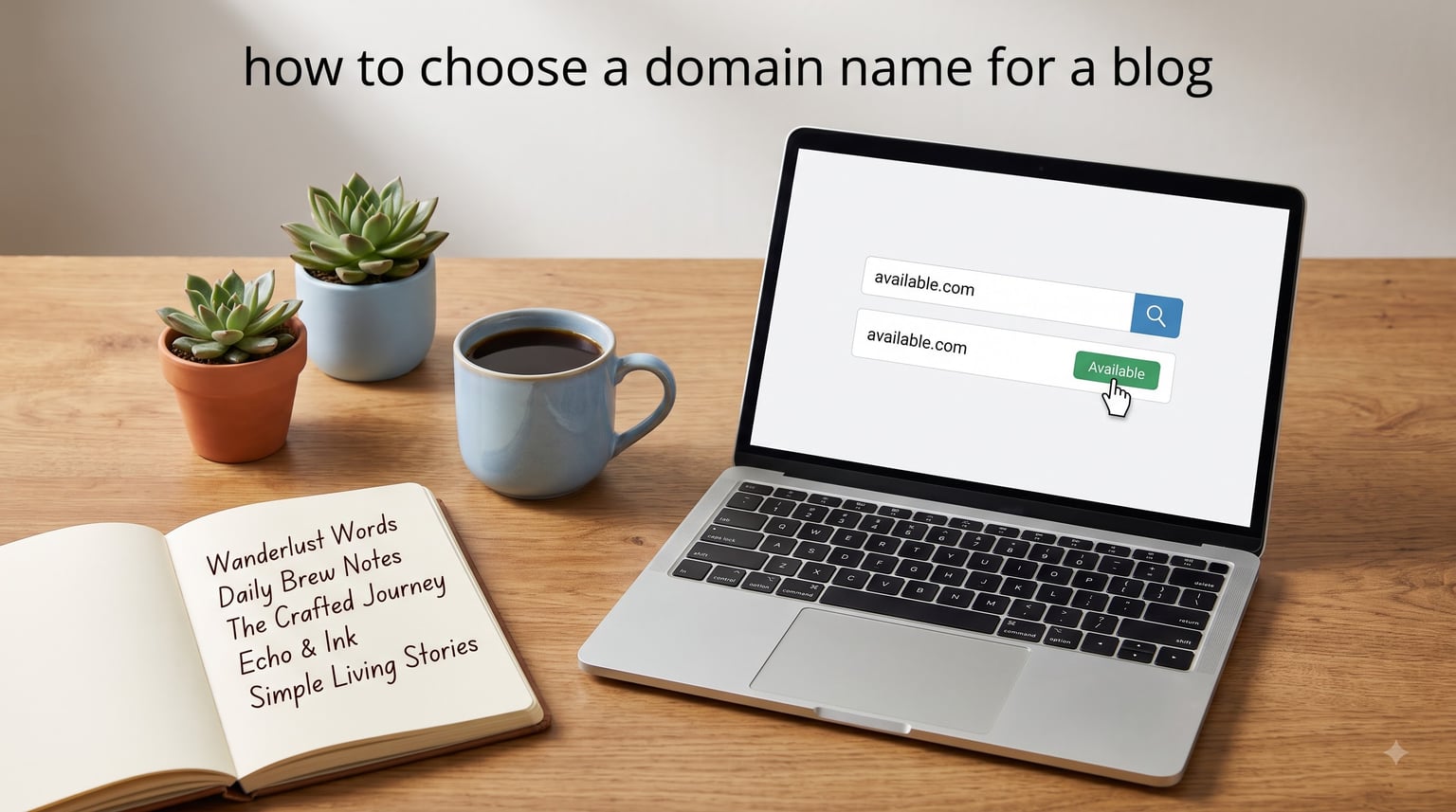
I have helped dozens of friends and readers launch blogs over the past few years, and the very first hurdle is almost always the same: picking the name. Learning how to choose a domain name for a blog feels deceptively simple until you actually try it. You type in five ideas, they are all taken, and suddenly you are staring at a registrars search bar at 1 a.m. wondering if “thebestblogever47.com” is really where your brand should live.
It does not have to be that painful. After guiding enough people through this process, I have settled on a workflow that takes an evening instead of a week, and it avoids the rebranding headaches that come from rushing the decision. Your domain is your address, your first impression, and a small but real SEO factor all rolled into one.
In this guide, I will walk you through everything that actually matters: branding versus keywords, extension choices, length and pronunciation rules, availability checks, trademark basics, and the mistakes I see first-time bloggers make over and over. By the end, you will have a shortlist of names you can register with confidence.
Table of Contents
Why Your Blog Domain Name Matters More Than You Think
Your domain name is often the very first thing a reader sees, sometimes before they even click. It shows up in search results, in social shares, in email addresses, and in every conversation where someone asks “what is your site called?” A strong name builds instant credibility, while a clumsy one creates friction at exactly the moment you are trying to earn trust.
Think of it like a sign on a storefront. A clean, memorable sign invites people in. A sign full of hyphens, numbers, and odd spellings makes people wonder if they are even at the right place. Readers judge quickly, and they judge silently.
There is also a practical lock-in effect. Changing your domain later means migrating your site, redirecting every old URL, rebuilding email accounts, and losing some search equity along the way. I have watched blogs lose months of momentum to a rebrand. The fifteen hours you spend choosing well now can save you fifteen weeks of cleanup later.
The good news: perfect is not required. Good, clear, and memorable beats clever and complicated every single time.
Keyword vs Brandable Domain Names: Which Path Fits Your Blog?
This is the debate that eats up more forum threads on r/Blogging than almost anything else, and both sides have a point. A keyword domain contains the topic itself, like “easyketorecipes.com”. A brandable domain is an invented or evocative name, like “Sumo” or “Backlinko”. Each approach wins in different situations.
Keyword Domains: Instant Clarity, Limited Ceiling
Keyword domains tell readers and search engines exactly what you cover, which helps with relevance and click-through in search results. For narrow, single-topic blogs, that clarity is genuinely valuable. Someone searching for keto recipes immediately knows what “easyketorecipes.com” offers.
The downside is the ceiling. If your keto blog evolves into general healthy cooking, your name now works against you. Keyword domains are also nearly impossible to build a distinctive brand around, and most of the good exact-match ones were registered years ago.
Brandable Domains: Harder Start, Bigger Long-Term Payoff
Brandable names start with zero built-in meaning, which feels like a disadvantage but is actually their strength. They are unique, they are usually short, and they give you total freedom to expand your topics. Neil Patel built a personal media brand on his own name; ProBlogger became an entire business rather than being trapped inside one keyword.
The trade-off is that a brandable name needs marketing to earn meaning. You are planting a seed rather than harvesting one. For most bloggers planning to stick with a topic for years and possibly grow beyond it, I lean brandable.
My Simple Tiebreaker
If your blog will forever be about one narrow topic and traffic will come mostly from search, a keyword-leaning name is fine. If you ever imagine expanding, building an email list, or turning the blog into a business, go brandable. When truly torn, a hybrid works too: a brandable name with one subtle topic hint inside it.
The Key Factors That Make a Blog Domain Name Work
Regardless of which naming path you choose, the same handful of qualities separate good domains from bad ones. I run every candidate through this list before it reaches my shortlist.
Keep It Short (Under 15 Characters)
WPBeginner recommends keeping domains under 15 characters, and my experience backs that up. Short names are easier to type, easier to say out loud, and harder to mistype. Every extra character is another chance for someone to get your URL wrong and land on an error page.
Easy to Spell and Easy to Say
Say your candidate name out loud to a friend over the phone, then ask them to type it. If they hesitate or ask “is that two Rs?”, throw it out. Reddit bloggers consistently warn against double letters and awkward spellings for exactly this reason: most sharing still happens verbally, and a name you cannot pronounce cleanly cannot spread by word of mouth.
Memorable Over Clever
A catchy domain name is one people can recall an hour after hearing it once. Alliteration, rhythm, and vivid imagery all help memorability. Obscure puns and inside jokes do not. If a reader cannot reconstruct your domain from memory tomorrow, it has failed the test.
DROP the Hyphens and Numbers
Hyphens and numbers are the two fastest credibility killers in domain naming. They look spammy, they are almost never spoken aloud correctly, and people forget whether your site is “best-blog-tips” or “bestblogtips”. When I see a hyphenated domain in search results, my expectations for the site drop before I even click. There are rare exceptions for numbers that are core to a brand, but as a rule: avoid both entirely.
Skip the Filler Words
Words like “the”, “my”, “our”, and “blog” itself pad your name without adding meaning. “TheEasyKetoRecipes.com” is just a worse version of a shorter name. Filler words are what people add when the name they wanted is taken, and it shows. Drop them and brainstorm fresh instead.
Watch Out for Homophones
Names containing words that sound like other words (“site”, “sight”, “cite”) create confusion every time your blog is mentioned in conversation or on a podcast. Check your candidate for accidental double meanings, including what the words look like smashed together with no spaces. Some innocent two-word names produce genuinely unfortunate strings when concatenated.
Domain Extensions Explained: .com, .blog, .net, and Beyond
Your extension, or top-level domain (TLD), is the suffix at the end of your web address. There are now over a thousand options, but in practice only a handful matter for blogs. Here is how the most common ones compare.
| Extension | Best For | Strengths | Watch Out For |
|---|---|---|---|
| .com | Almost everyone | Most trusted, most memorable, default assumption | Hardest to get a short name in |
| .blog | Bloggers wanting topic clarity | Instantly signals content type, modern feel | Newer, slightly less familiar to older readers |
| .net / .org | Tech and nonprofit-leaning sites | Recognized and trusted alternatives | Visitors often mistype as .com |
| .co | Startups, brandable names | Short, reads as “company” | Confusable with .com in speech |
| .io | Tech and developer blogs | Strong tech-community signal | Higher renewal cost, less intuitive for general audiences |
| Country codes (.co.uk, .ca) | Local audiences | Great for geo-targeted content | Limits perceived international reach |
My advice is simple: get the .com if you possibly can. It is still the extension people type by reflex when they remember a name but not the full address. If the .com of your dream name is taken, a strong brandable name on a .com beats a exact-match keyword name jammed onto a obscure extension.
That said, .blog deserves a fair hearing for content sites. A short, clean name on .blog can work beautifully when the name itself is distinctive. Just know that you will occasionally need to remind people of the extension, and strongly consider buying the matching .com as well if it fits your budget, then redirecting it.
How to Choose a Domain Name for a Blog: My 7-Step Workflow
Here is the exact process I use, refined over many launches. It is designed to get you from blank page to registered domain in one focused evening.
Step 1: Define Your Blog’s Core Topic and Future Direction
Write one sentence describing what your blog covers today, and one describing what it might cover in three years. This exercise immediately reveals whether a narrow keyword name will box you in. I learned this the hard way: my first blog was named so tightly around one tool that pivoting to the broader topic made the name nonsensical.
Step 2: Brainstorm 20 Names Without Judging Any of Them
Quantity first, quality later. Write down combinations of topic words, evocative adjectives, personal elements, and invented words. Use a timer and do not stop to evaluate anything for fifteen minutes. Most of the first ten ideas will be unusable; the good ones usually hide in the second half of the list.
Step 3: Cut the List Against the Quality Factors
Now judge. Run each candidate against the factors above: under 15 characters, easy to spell, easy to say, no hyphens, no numbers, no filler words, no homophone traps. Most lists of twenty collapse to four or five survivors at this stage, which is exactly what you want.
Step 4: Check Availability at a Reputable Registrar
Search your survivors at an ICANN-accredited registrar, and check multiple extensions at once. One warning from the forums that is absolutely worth repeating: some registrars have been accused of holding searched names, so avoid checking final candidates at sketchy lookup tools before you are ready to buy. When you find the one, register it promptly.
Step 5: Check the Domain’s History
This step is skipped by almost every competitor guide, yet it matters. A domain that hosted spam or was dropped by a penalized site can carry baggage. Paste your candidate into the Wayback Machine at archive.org to see what lived there before, and search the name in Google to surface any past associations. A clean history means a clean start.
Step 6: Verify Social Media Handle Availability
Check whether the matching handle is free on the platforms you plan to use, ideally the same name across all of them. Namechk and similar tools check dozens of networks at once. Consistency between your domain and your handles makes you easier to find and protects your brand from impersonation later.
Step 7: Sleep On It, Then Register for Multiple Years
Give yourself one night away from the name before committing. If it still sounds right in the morning, register it, and consider a multi-year registration. A longer registration term signals stability, and it removes the risk of an accidental lapse costing you the name you built.
Personal Name vs Topic-Based Domains
Using your own name is a genuinely viable path, and for certain goals it is the best one. FirstnameLastname.com domains have carried the personal brands of writers, consultants, and marketers for years. If you are the product, meaning you sell services, speaking, books, or freelance work, a personal domain gives you career-long portability across every topic you might ever cover.
The strengths are real: personal domains never go out of date, they build recognition for you directly, and they are usually available since full names are fairly unique. Readers connect with people more strongly than with topic labels, and a personal domain leans into that.
The weaknesses are equally real. A personal name tells a visitor nothing about your subject matter, so you carry the full burden of communicating your topic through your title tag and content. Personal domains also make a blog harder to sell or hand off later, and they feel awkward if the blog grows into a multi-author publication.
My rule of thumb: if the blog is your portfolio or personal platform, use your name. If the blog is a standalone media property or business, use a topic-based or brandable name.
Common Mistakes to Avoid When Picking a Blog Domain
These are the errors I see most often, pulled from forum threads and my own painful observations of first launches. Each one is completely avoidable with a few minutes of care.
- Naming the blog before checking availability. People fall in love with a name, print it on half their materials, and only then discover the domain is taken or priced at thousands of dollars. Always check availability before committing emotionally.
- Choosing a name too close to a competitor’s. Being “the second half” of an existing popular domain guarantees you will send them free traffic from confused visitors.
- Locking yourself into a micro-niche. “VeganCasseroleBlog.com” is perfect until you want to write about anything else. Leave room to grow.
- Using tricky spellings of common words. “Krafty” and “Kwik” force you to spell your domain aloud for the life of your blog.
- Ignoring how the name reads mashed together. Always preview the full string with no spaces before registering.
- Picking a trendy reference that will age badly. Pop-culture puns feel dated within a couple of years, and dated is worse than boring.
- Rushing the decision in one sitting. The worst names come from deadline fatigue at midnight. Sleep on your finalists.
Future-Proofing Your Blog Name
The most common regret I hear from bloggers is not “my name is bad”, it is “my name is too small for what my blog became”. Future-proofing means choosing a name wide enough to absorb the topics you will plausibly add within a few years. Geographic names break when you move. Platform names break when the platform fades. Single-product names break the moment you broaden.
A practical test: imagine your blog three years from now with twice the scope. Does the name still fit naturally? If the answer requires a stretch, widen the name now. Slightly broader today prevents a rebrand tomorrow.
It is also worth registering common misspellings of your final choice and redirecting them to your main domain, assuming they are available at standard prices. Every mistyped URL recovered is a reader kept.
Checking Availability and Social Media Handles
The availability check deserves more care than most people give it. Beyond the registrar search, look at whether the name is active as a trademark, whether someone is squatting on the social handles, and whether the matching name is in use on YouTube or as an email address. A name that is free as a domain but heavily occupied elsewhere fragments your brand from day one.
Tools like Nameboy and DomainsBot are useful for sparking ideas and checking availability across extensions in one pass. For a full picture of social availability, run your finalists through a handle-checking tool before you commit. The goal is one name, everywhere, owned by you.
One habit worth adopting from experienced domain buyers: do your final availability searches in a private browser window at a registrar you actually intend to use, and register the same day you decide. This minimizes any risk of the name being snapped up in the window between your search and your purchase.
Trademark and Legal Considerations
A domain can be available to register and still legally problematic, and this distinction trips up a lot of first-time bloggers. If your name is confusingly similar to an existing trademark in a related category, the trademark owner can come after the domain, and disputes over registered trademarks tend to end with the trademark holder winning.
Before registering, search your candidate in the USPTO trademark database if you are in the United States, or your country’s equivalent registry elsewhere. Also run a plain Google search for the name plus the word “blog” or “brand” to catch unregistered but established businesses using it. Ten minutes of searching can prevent a forced rename after you have built an audience.
Two more quick points. Avoid names that play on famous brands, even as parody, since large companies enforce aggressively. And if your blog turns into a business, consider registering your own trademark to protect the name you worked to build.
Quick Checklist for Choosing Your Domain Name
Here is the whole guide compressed into a single checklist you can run against any candidate. If a name clears every line, it is a keeper.
- The name is under 15 characters.
- It passes the phone test: someone can hear it once and type it correctly.
- It contains no hyphens, numbers, or filler words like “the” and “my”.
- The .com is available, or you have a deliberate reason for another extension.
- The name leaves room for your blog to expand beyond its current topic.
- The domain has no spammy or penalized history in the Wayback Machine.
- Matching social media handles are available on your priority platforms.
- No conflicting trademark or established brand is using a confusingly similar name.
- It still sounds good after sleeping on it for a night.
Frequently Asked Questions
What should you avoid when choosing a domain name?
Avoid hyphens, numbers, double letters, filler words like the or my, and tricky spellings. Also avoid names that box your blog into one micro-niche, names too close to a competitor or existing trademark, and any name that fails the phone test where someone hears it once and cannot type it correctly.
How to pick the perfect domain name?
Define your topic and future direction, brainstorm 20 candidates, cut the list against criteria like length under 15 characters and easy spelling, check availability at a reputable registrar, verify the domain has no spam history, confirm matching social handles are free, then sleep on it and register for multiple years.
What is a catchy domain name?
A catchy domain name is short, easy to pronounce, and memorable enough that readers can recall it an hour after hearing it once. Alliteration, rhythm, and vivid imagery help. Clever puns and obscure spellings do the opposite, so aim for memorable over clever.
Should I use my own name for my blog domain?
Use your own name if you are building a personal brand, selling services, or want career-long portability across topics. Choose a topic-based or brandable name if the blog is a standalone property you might grow, monetize independently, or sell later.
Which domain extension should I choose for my blog?
Choose .com whenever the name you want is available there, because it is the most trusted and the default people type from memory. If the .com is taken, a short brandable name on .blog or .net can work well, and country codes like .co.uk are strong for purely local audiences.
Final Thoughts on Naming Your Blog
Knowing how to choose a domain name for a blog comes down to a few honest tests: can people spell it, say it, remember it, and will it still fit your blog in three years? Run your candidates through the workflow and checklist above, and the right name will make itself obvious.
Do not wait for perfection, because a good name registered today beats a perfect name contemplated for a month. Pick your winner, grab the .com, secure the matching handles, and start writing. The blog you build matters far more than the name on the door, but a name chosen well removes one obstacle from your path.