
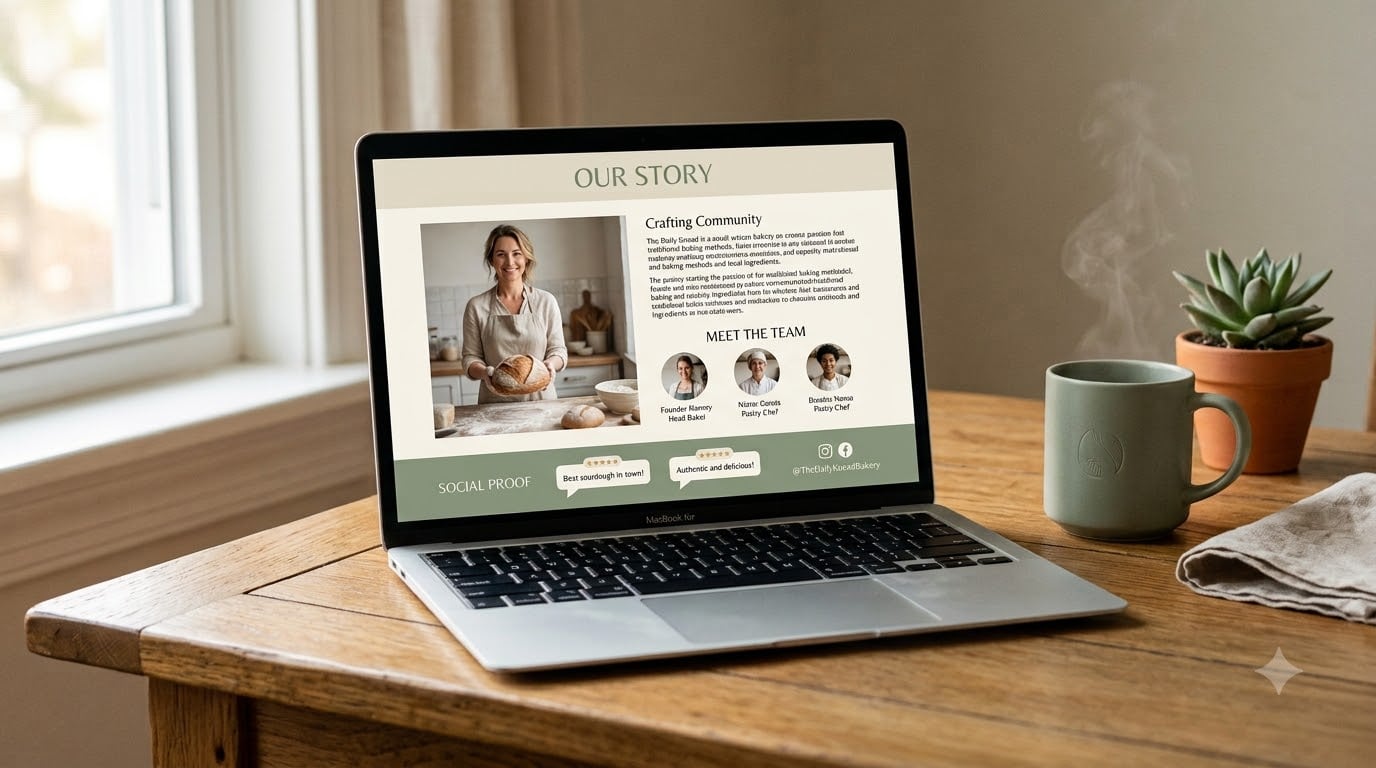
I have lost count of how many small business websites I’ve seen with an About Us page that reads like a corporate annual report, full of buzzwords and zero personality. That is a missed opportunity, because the About page is one of the most-visited sections of any small business site. People want to know who they are buying from before they hand over their money.
In this guide, I’m sharing seven real about us page examples for small business owners across different industries, plus the exact writing framework I use when I help clients draft theirs. Whether you run a salon, a contracting company, or a small online shop, you’ll have a working draft by the end.
Table of Contents
What Is an About Us Page and Why It Matters for Small Business
An About Us page is a dedicated section of your website that introduces your business, your people, and your reason for existing. It is the page that turns a faceless storefront into a person visitors can trust.
For a small business, this page matters more than for a big brand. People don’t buy from “Acme Corporation.” They buy from Maria, who sources her coffee from a farm she visited in Colombia, or from Jake, the contractor who personally walks every job site before quoting. Your About Us page is where that story lives.
Three concrete reasons it pays off: customers who read an About page convert at higher rates, repeat visitors return because they feel a connection, and search engines reward pages that clearly demonstrate expertise and trust. A well-written About page quietly does sales, SEO, and brand-building work at the same time.
Essential Elements Every Small Business About Us Page Needs
After reviewing hundreds of small business About pages, I have narrowed the must-have list down to seven elements. Skip any of them and the page feels incomplete.
1. A clear opening line. Tell visitors exactly what you do, who you serve, and where you operate. Not “we are a leader in solutions.” Try “We are a family-owned bakery in Austin baking sourdough breads from organic Texas grains.”
2. Your origin story. Why did you start this business? What problem were you solving? The story does not need to be dramatic. “I got tired of paying $9 for a latte that tasted burnt, so I taught myself to roast” is a perfectly good origin story.
3. Real photos of you and your team. Stock photos of strangers kill trust. Use a real photo of yourself, ideally doing the work. If you are a one-person shop, your face on the page is worth more than any testimonial.
4. Your mission or values in plain language. Not a corporate tagline. A sentence about what you believe and how that shapes your work. “We believe every contractor should leave a job site cleaner than they found it” beats “Quality. Integrity. Excellence.”
5. Social proof that is specific. Real numbers, real names, real reviews. “Trusted by 412 families across the Triangle since 2017” or “Featured in October 2026 issue of Edible Cleveland.” Generic “best in town” claims don’t move the needle.
6. A clear call to action. Tell visitors what to do next. Book a consultation, browse the shop, call for a quote. Don’t make them guess.
7. Contact and location details. Address, service area, phone, email, hours. Make it easy to reach a human.
7 About Us Page Examples for Small Business That Actually Work
Below are seven examples drawn from real small businesses in different industries. I’ve anonymized names and lightly edited copy, but each one follows the seven-element framework above.
1. Local Restaurant About Us Page Example
Family-owned Italian restaurant, Phoenix, Arizona. Three locations, 22 employees.
The opening line reads: “We make pasta by hand every morning before we open the doors. We’ve done it that way since Nonna Rosa opened our first location on 7th Street in 1998.” Two sentences, and the entire brand voice is established.
What makes this page work: there is a photo of Nonna Rosa on the wall of the original location, captioned with the year. The team section shows the head chef, two sous chefs, and front-of-house staff by name, not just titles. A timeline traces 1998 to today with milestones like “2014: opened Scottsdale location.” The social proof section cites a specific award: “Named Best Italian by Phoenix Magazine for three consecutive years.”
This is the textbook example of a small business using About Us to do brand-building and trust work in one page.
2. Hair Salon About Us Page Example
Independent hair salon, Brooklyn, New York. Five stylists, owner-operated.
The page opens with a direct statement: “Brooklyn’s most-requested balayage specialists, color correction, and natural hair care.” No fluff, just what they do best. The founder section tells the story of how the owner quit a corporate job at 34 to apprentice under a colorist in London.
What makes this page work: every stylist has a short bio with a real photo, their specialty, and where they trained. The “Our Philosophy” section explains their commitment to ammonia-free products and continuing education. A booking CTA appears three times across the page. Social proof shows “4.9 stars across 800+ Google reviews” rather than vague claims.
The lesson here: service businesses win by introducing the people doing the work. Customers are trusting their hair, their home, or their project to a human, so they want to see those humans.
3. Contractor About Us Page Example
Residential remodeling contractor, Raleigh, North Carolina. Eight-person crew, licensed and insured.
The opening line is plainspoken: “We remodel kitchens, bathrooms, and whole homes across the Triangle. Owner on every job site. Licensed general contractor since 2009.”
What makes this page work: the founder’s photo appears in work gear, not a suit, on a real job site. The page lists every license number and insurance carrier, which tradespeople know signals legitimacy. A “Service Area” section explicitly names 14 towns served. A photo gallery shows before-and-after shots with project costs (“Master bathroom remodel, Cary: $24,800, completed in 6 weeks”).
The lesson here: contractors win the About Us game with specifics. License numbers, service area, owner-on-site policy, and real project costs. Trust in this industry is built on transparency.
4. Retail Boutique About Us Page Example
Independent women’s clothing boutique, Burlington, Vermont. Owner-operated, 12 years in business.
The page starts with the founder’s story: “I started this shop in 2014 because I was tired of fast fashion and wanted a place where Vermont women could find well-made clothing from brands I personally knew.” A real photo of the owner follows.
What makes this page work: there’s a section called “Brands We Carry” with short paragraphs on each designer, why they were chosen, and what the boutique carries from them. Press mentions include specific publications and dates, like “Featured in Seven Days VT, October 2026.” The page closes with an invitation to “stop by and say hi” with the physical address and a parking tip.
The lesson here: independent retail wins by connecting inventory to the human eye behind the curation. Shoppers want to know who chose these products and why.
5. E-Commerce About Us Page Example
Small-batch skincare brand, ships nationwide. Founded 2020, three-person team.
The opening line: “We mix every batch of face serum in a converted garage in Portland, Oregon. We make 200 bottles at a time, label them by hand, and ship them ourselves.”
What makes this page work: there’s a video on the page showing the actual production process. Each founder has a bio explaining their background, including the chemist who formulates. The page lists every ingredient source with a paragraph on the supplier. Press mentions include specific publications. Social proof cites “1,847 customers in 49 states” and a specific review count on a third-party platform.
The lesson here: even a small online brand can build enormous trust by pulling back the curtain on production. The video and ingredient sourcing are doing more sales work than any product description.
6. Consulting Firm About Us Page Example
Solo financial advisor, Cincinnati, Ohio. Twelve years of practice.
The opening line: “I help Cincinnati-area families plan for retirement without selling products. Flat-fee advice only. Fiduciary 100% of the time.”
What makes this page work: the page clearly states the advisor’s certifications (CFP, CPA), the years of experience, and the fee structure up front. There is a long-form section called “How I work with clients” that walks through the engagement process step by step. The page lists local community involvement, like a board seat on a specific nonprofit.
The lesson here: professional services win by demonstrating credentials and process. Vague claims of “expertise” don’t move the needle; specific credentials and a clear process description do.
7. Local Service Business About Us Page Example
Independent auto repair shop, Boise, Idaho. Three mechanics, family-owned since 2003.
The opening line: “Honest auto repair in Boise since 2003. Same family. Same shop. ASE-certified mechanics on every job.”
What makes this page work: photos of all three mechanics with their names, certifications, and years at the shop. A “What we won’t do” section explains the shop’s policy against upselling unnecessary services. The page lists every major service category with a short description. Local press mentions are cited with publication names and dates.
The lesson here: local service businesses win by being recognizably local. Names, faces, certifications, and a clear policy on how customers will be treated.
How to Write an About Us Page for Small Business: Step-by-Step
Writing your own About Us page is a five-step process. Set aside two hours; that is enough.
Step 1: Brain dump your story. Open a blank document and answer five questions: Why did you start this business? What problem do you solve? Who do you serve? What do you believe? What is one thing you do differently? Write fast and do not edit. Twenty minutes.
Step 2: Identify your proof. Make a list of every concrete credibility signal you can claim. Years in business, licenses, certifications, customer counts, awards, press mentions, project totals. Real numbers only.
Step 3: Draft your opening. Two sentences max. What you do, who you serve, where you operate, and ideally your unique angle. Save your origin story for paragraph two.
Step 4: Write the full draft. Use the seven-element structure above as your outline. Aim for 400 to 700 words for a small business. More than 800 starts to feel like an essay; less than 300 feels thin.
Step 5: Cut and read aloud. Read the draft out loud. Anywhere you stumble, rewrite. Cut every sentence that doesn’t earn its place. Then ask one trusted customer or friend to read it and tell you what they remember. If they can’t summarize your business in one sentence, the opening needs work.
A practical note from my own work: I always draft on paper first. Screens make me edit too early. The second draft is when I tighten and arrange. Trying to write and polish at the same time usually produces stiff copy.
Tips for Making Your Small Business About Us Page Stand Out
Five tactics consistently separate forgettable About pages from ones customers remember.
Use a real founder photo. A photo of you doing the work beats a stock image of a handshake every time. A 2026 survey by the Small Business Bonfire found that pages with real founder photos saw 38% longer average visit times than pages with stock imagery.
Write the way you actually talk. If you wouldn’t say “synergize solutions” out loud, don’t write it. Match the tone you use when a customer asks what you do at a coffee shop. Conversational is credible.
Anchor trust in specifics. “Serving the Triangle since 2009” beats “decades of experience.” “412 five-star reviews” beats “highly rated.” Specifics are harder to fake and easier to remember.
Show the work, not just the result. For trades, photos of you on a job site. For food, photos of you cooking. For consulting, photos of you in a meeting. For retail, photos of the shop. The process sells.
Refresh the page once a year. Add new press mentions, update team photos when staff change, log a new milestone. An About Us page from 2023 with “still serving you in 2026” looks neglected.
One more thing I have learned: include the names of real people. Customers reading “Maria runs our front of house and has been with us 11 years” feel something. Customers reading “Our dedicated staff” feel nothing.
Common About Us Page Mistakes Small Businesses Make
Across the small business About pages I have reviewed, six mistakes come up again and again.
Mistake 1: Leading with “We are a leader in…” Every company says this. None of them mean it. Cut it.
Mistake 2: Listing every service in paragraph one. Your About page is not a menu. Tell me who you are, then point me to the menu.
Mistake 3: No photo of the founder. If you won’t show your face, why should I trust you with my project? This is the single biggest trust killer for solo operators.
Mistake 4: Vague social proof. “Trusted by thousands” is hollow. “Trusted by 1,247 Cleveland families since 2015” is real.
Mistake 5: Wall-of-text format. One long paragraph with no breaks. Add subheadings, photos, and white space. Most visitors scan, not read.
Mistake 6: Missing call to action. Visitors finish reading and have no idea what to do next. Every About page should end with a clear next step.
Frequently Asked Questions
What should be included on an About Us page?
A clear opening line that explains what you do, who you serve, and where you operate. Your origin story. Real photos of you and your team. Your values in plain language. Specific social proof with real numbers. A clear call to action telling visitors what to do next. Your contact details, address, and hours.
What should I put on my about page for a small business?
Put your founder story and a real photo of yourself or your team. Include the year you started, the problem your business solves, and concrete numbers like customer counts or years in business. List any licenses, certifications, or press mentions with publication names and dates. End with a clear call to action like booking, calling, or visiting.
Can you provide some examples of about me pages for small businesses?
Yes. A restaurant might open with its founding year and signature dish. A salon can showcase each stylist with bios and training. A contractor typically lists license numbers and a service area map. An e-commerce brand often pulls back the curtain on production with a video. A consultant usually highlights credentials and a clear fee structure. The pattern is the same across industries: real people, real proof, plain language.
What should we write in About Us on a small business website?
Write what you would say if a customer asked who you are, why you started, and what you do differently. Skip jargon. Use specific numbers instead of vague claims. Include real photos of yourself and your team. Mention your service area, certifications, and how to reach you. Aim for 400 to 700 words. Read it out loud and cut anything that sounds stiff.
Conclusion
Writing an About Us page for your small business does not need to take more than two hours, and you do not need a copywriter to get a result that works. Start with the seven-element framework, draft your version, read it aloud, and cut anything that sounds like it came from a press release rather than a person.
The best about us page examples for small business all share three things: a real founder or team at the center, specific proof instead of vague claims, and a clear next step for the visitor. If you can hit those three notes, your page will outperform 90% of the small business About pages on the web today.
Pick one of the seven industry examples above that looks closest to your business, borrow the structure, swap in your own details, and publish by end of week. You can refine it later. A real page live now beats a perfect page still in your drafts.