
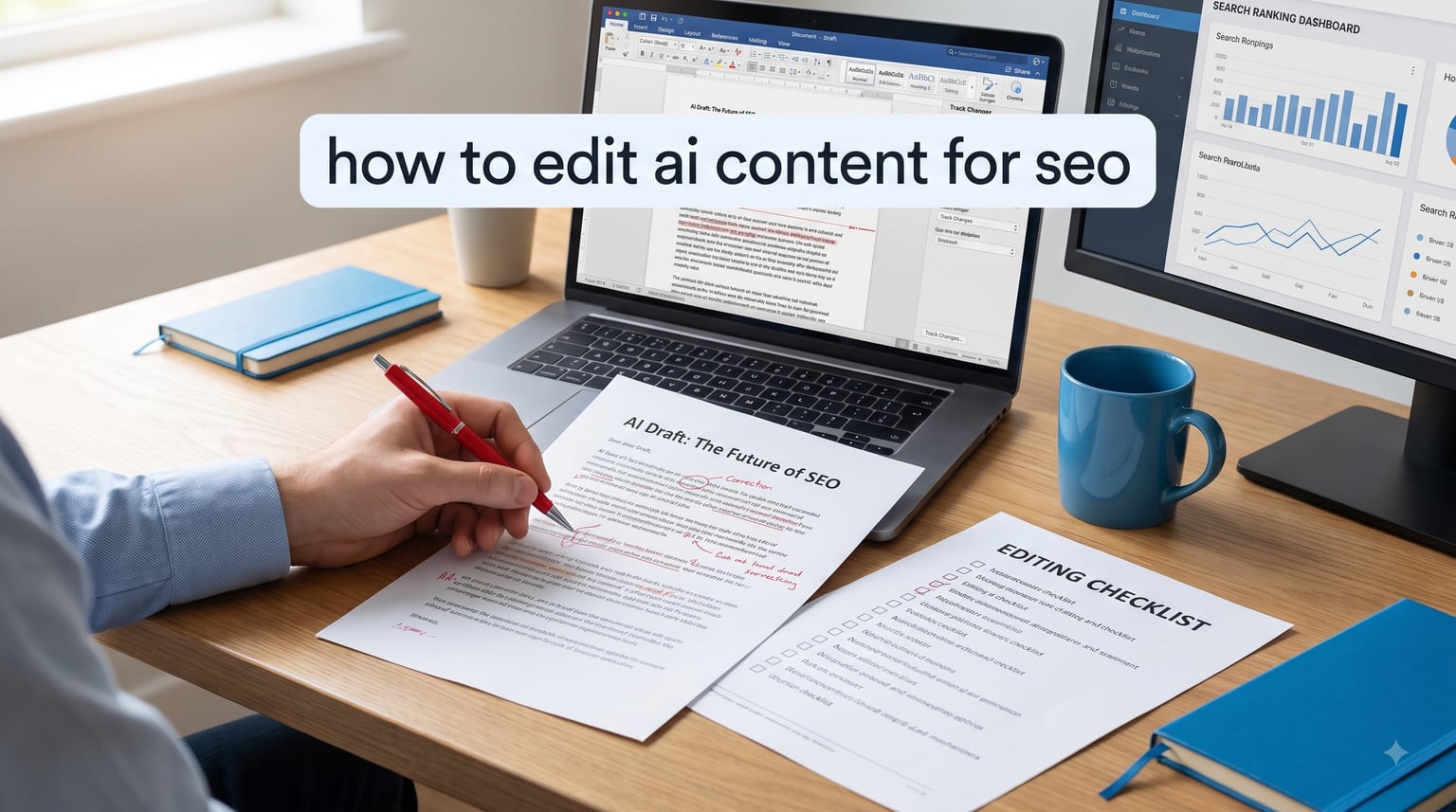
Learning how to edit AI content for SEO is the difference between pages that rank and pages that quietly die on page nine. I run a content team that publishes dozens of AI-assisted articles every month, and I can tell you the pattern is always the same. The draft comes out fast, looks polished, and is completely unusable until a real edit fixes it.
Google’s own guidance is clear on this point: the search engine rewards content however it was produced, as long as it is helpful, accurate, and created for people first. That means AI content is not the problem. Unedited AI content is. In this guide, I’ll walk you through the exact process we use to turn raw AI drafts into articles that rank, earn trust, and sound like a human wrote them, because a human did finish them.
Table of Contents
What Editing AI Content for SEO Actually Means
Editing AI content for SEO is the process of refining an AI-generated draft so it is accurate, authentic, readable, and optimized for search, while keeping a natural human voice. It combines traditional editing with fact-checking, brand voice alignment, and on-page SEO work in a single pass.
Think of the AI draft as a very fast intern’s first attempt. The structure might be decent and the grammar clean, but the reasoning, the examples, the data, and the personality all have to come from you. Content marketers, SEO professionals, and business owners who use AI writing tools all need this step. Skipping it is how you end up with content that, as one Reddit user in r/SEO put it, “checks every SEO box but sounds like it was written by committee.”
How to Edit AI Content for SEO: The Step-by-Step Process
Here is the exact workflow I use, in order. Each step builds on the last, so resist the urge to jump straight to keyword tweaking. Fixing foundations first saves you from reworking paragraphs you already polished.
Step 1: Read the Full Draft Before Changing Anything
Read the entire draft top to bottom without editing. You are looking for the overall argument, structural gaps, and sections that repeat themselves. AI models often pad drafts with three paragraphs saying the same thing in slightly different ways. Mark those now.
Step 2: Verify Every Fact, Statistic, and Claim
AI tools state falsehoods with total confidence. Every statistic, date, study, and named fact needs to be checked against a primary source before publication. This is the single most important step, and I cover it in depth later in this guide.
Step 3: Delete the Filler
Cut throat-clearing introductions, generic definitions nobody searched for, and conclusion paragraphs that just restate the intro. A good rule: if deleting a sentence changes nothing about the reader’s understanding, delete it. Most raw drafts shrink by 20 to 30 percent during this step, and they get better, not shorter.
Step 4: Rewrite for Sentence Variety
AI writing defaults to uniform sentence length and rhythm, often starting consecutive paragraphs the same way. Break this up deliberately. Short sentence. Then a longer one that carries an idea with some room to breathe. Then a medium one to land the point.
Step 5: Inject First-Person Experience and Real Examples
Add something the model could not have known: a result from your own testing, a screenshot of your workflow, a mistake you made. This is what both readers and search evaluators recognize as experience. One specific anecdote does more for credibility than a thousand words of fluent generalities.
Step 6: Match Your Brand Voice
Swap generic phrasing for the words and tone your audience actually uses. If your site is direct and casual, the draft’s corporate smoothness has to go. Read a paragraph aloud, and if it does not sound like you, rewrite it until it does.
Step 7: Apply On-Page SEO
With the content solid, handle title tags, meta descriptions, the primary keyword in the first paragraph, H2 structure, internal links, and image alt text. Doing SEO work last means you are optimizing real content, not polishing text that will be rewritten. I break down the full checklist in a dedicated section below.
Step 8: Final Human Read-Through
Read the finished piece one more time, out loud if possible. You are checking flow, catching typos that survived every tool, and confirming the article actually answers the search intent behind the query. If a section feels like it was written to satisfy a checklist rather than a reader, fix it or cut it.
How to Spot Unedited AI Content Patterns
You can train yourself to recognize unedited AI content in seconds. Certain phrases repeat across tools because the underlying models converge on the same safe, generic patterns. When I audit sites, these are the tells I look for.
Watch for hedge-everything constructions like “it’s important to note that” and “in the ever-evolving world of.” Watch for rule-of-three sentences where every list has exactly three perfectly balanced items. Watch for symmetrical paragraph lengths, zero contractions, and a suspicious absence of any specific number, name, or date.
Other reliable tells: an intro that defines the topic instead of answering the question, subheadings that all follow the exact same grammatical pattern, and a conclusion that begins with “in conclusion.” If a draft shows three or more of these patterns, it needs a serious edit, not a light polish.
Fact-Checking AI Content Without Losing Your Weekend
Here is the honest truth from the trenches: fact-checking is the slowest part of editing AI content. A frequent complaint in SEO communities is that verifying an AI draft takes longer than writing the piece manually would have. I’ve felt that frustration, and the only fix is a system.
Start by highlighting every factual claim in the draft, literally selecting them in your editor. AI drafts of 1,500 words typically contain 10 to 20 checkable claims. Then verify each one against a primary source, which means the original study, the official documentation, or the tool’s own site, never another blog post that cited it.
For statistics, my rule is simple: if I cannot find the primary source in five minutes, the statistic gets deleted or replaced with one I can verify. Fabricated or misattributed statistics are the most damaging AI failure because they are invisible until someone checks. A reader who catches one fake number never trusts the article again, and neither does a search evaluator.
Pay special attention to dates, version numbers, pricing, and anything about a fast-moving field. AI training data has a cutoff, so the model confidently describes tools and features that changed months ago. Anything time-sensitive gets checked against the live source, every time.
Restoring Brand Voice and Human Perspective
Brand voice is the pattern of word choices, tone, and perspective that makes your content recognizable. AI drafts arrive voice-neutral by default, which is why every unedited AI article on the internet sounds vaguely like every other one. Your edit is where the voice comes back.
The fastest method is to keep two or three of your best human-written articles open while editing. When a sentence feels flat, ask how you said the same kind of thing in those pieces. Did you use contractions? Did you ask the reader direct questions? Did you admit uncertainty? Copy those habits.
For B2B and technical audiences, voice also means respecting expertise. Senior engineers and experienced practitioners instantly reject content that over-explains basics or glosses over nuance. Add the caveat the model left out, name the edge case, and cite the standard. Depth is a voice, too.
SEO-Specific Optimizations to Make While Editing
Most editing guides stop at “make it sound human.” That is not enough for search. This is the phase competitors barely cover, and it is where your edited draft actually earns rankings.
Align With Search Intent Before Anything Else
Confirm the draft answers what the searcher actually asked. A query like “how to edit ai content for seo” wants a process, so the article needs visible, numbered steps. If the intent is comparison, the draft needs a clear verdict. Edit for intent first, keywords second.
Place Keywords Naturally
Your primary keyword belongs in the title, one H2, the first paragraph, and the conclusion, at a density around one percent. Forced exact-match repetition reads badly and no longer helps. Work in related terms like “fact-checking AI content,” “brand voice,” and “editing workflow” where they fit organically.
Fix Heading Structure
Use one H1, logical H2s, and H3s beneath them. Descriptive subheadings help search engines parse your article and give you multiple ranking entry points. They also let you pull question-based phrases from People Also Ask results into your H2s and H3s, which is a proven snippet capture tactic.
Add Internal and External Links
Insert links to your related articles so readers and crawlers can follow topical paths. Add one or two outbound links to authoritative primary sources, which supports the fact-checking step and signals diligence. Fix or remove any broken or hallucinated links the draft invented.
Structure for Featured Snippets
Featured snippets pull definitions, numbered lists, and short direct answers. Put a two-sentence direct answer immediately under any question-style heading. Keep numbered lists clean, with each step starting with an action verb. This formatting costs nothing and wins positions.
Optimize Images and Formatting
Add alt text that describes images plainly, break walls of text into short paragraphs, and use bullets where they genuinely help. Engagement signals like scroll depth and time on page correlate with formatting quality, so this is SEO work, not decoration.
Readability Fixes That Make AI Drafts Sound Human
Readability is where the AI fingerprint gets erased. Beyond sentence variety, a few specific fixes do most of the work. Vary paragraph length, including the occasional one-line paragraph for emphasis, like this one.
Replace abstract nouns with concrete ones. “Implement a content refinement workflow for quality enhancement” becomes “set up a simple editing checklist.” Contractions, direct address using “you,” and the occasional rhetorical question all push the prose toward how people actually talk.
Finally, check transitions. AI models often connect paragraphs with “furthermore”-style connectors or with nothing at all. Real writing moves between ideas causally: because of that, therefore, which is why. Fix the connective tissue and the whole piece starts to feel authored.
AI Content and Google Rankings: Penalties, the 30 Percent Rule, and What Actually Matters
Google does not punish AI content simply for being AI-generated. Google’s stated position rewards helpful, reliable, people-first content regardless of how it was produced, and penalizes spammy, unoriginal, mass-produced pages regardless of how they were produced. The risk is not the tool. It is publishing unhelpful, unverified drafts at scale.
You may have heard of the 30 percent rule, the idea that you should change at least 30 percent of AI-generated text to make it rank or avoid detection. Understand clearly: this is folklore, not a Google guideline. No search engine counts edited percentages. What matters is whether the final article demonstrates experience, expertise, trustworthiness, and accuracy. Editing 30 percent of a weak draft still leaves a weak draft.
That said, the spirit behind the rule is sound. Substantial human revision, the kind that adds real data, real examples, and real perspective, is exactly what separates ranking AI-assisted content from ignored AI-assisted content. Edit for quality, not for an arbitrary threshold.
Tools That Speed Up AI Content Editing
No tool replaces judgment, but the right stack cuts editing time dramatically. I group them by the job they do in the workflow.
Grammar and clarity checkers catch mechanical issues and flag passive voice, and most now include tone and readability scoring. Readability scoring tools show grade level at a glance, which helps when you need to hit a general-audience target. Plagiarism checkers confirm your draft is not echoing existing pages word for word, a real risk since models can reproduce familiar phrasing.
AI detection tools deserve a specific warning. They are unreliable in both directions, frequently flagging human writing as AI and missing AI writing entirely. Do not build your editing process around beating a detector. Build it around producing content a human reader trusts. That standard is higher, and it is the one search engines actually apply.
The last tool in the stack is the simplest: your CMS draft mode and a checklist. A saved editing checklist, applied the same way every time, outperforms any single app because it makes quality repeatable across every writer on your team.
Common Mistakes to Avoid When Editing AI Content
I see the same failure modes over and over when teams bring me their AI content problems. Avoid these and you are ahead of most of the market.
The big ones: publishing with zero fact-checking because the draft “read fine,” keyword-stuffing during the SEO pass, deleting all personality in pursuit of a readability score, skipping the read-aloud final check, and treating a green AI-detector score as proof of quality. Teams also tend to over-edit short content and under-edit long content, when the opposite is usually safer.
The subtle mistake is editing sentence by sentence while never checking whether the article as a whole says anything. Polish cannot rescue an argument that isn’t there. If the core thesis is weak, regenerate the outline with better direction rather than sanding a rough draft of an idea not worth publishing.
Quick Edit vs Comprehensive Edit: When to Use Each
Not every piece needs the full eight-step treatment. I split edits into two tiers and choose deliberately before starting.
A quick edit suits short, low-stakes, non-competitive content like internal notes or brief updates. It covers fact-checking claims, deleting obvious filler, a grammar pass, and basic SEO tags. Expect 15 to 30 minutes per piece.
A comprehensive edit is for anything targeting competitive keywords or representing your brand. That is the full workflow: structural review, deep fact-checking, voice rewriting, experience injection, complete SEO optimization, and snippet formatting. Expect one to two hours per 1,500 words. The content that wins rankings in 2026 lives in this tier, because the competition is editing seriously even when the drafts came from the same tools.
Frequently Asked Questions
How do you modify AI generated content?
Modify AI generated content by fact-checking every claim, deleting filler and repetition, rewriting for sentence variety, adding your own examples and perspective, matching your brand voice, then applying on-page SEO. Always finish with a full human read-through before publishing.
Does Google punish AI content SEO?
No. Google has stated it rewards helpful, reliable, people-first content regardless of how it was created. Penalties target spammy, unoriginal, mass-produced pages, whether written by AI or humans. Edited, accurate, genuinely useful AI-assisted content can rank normally.
What is the 30 percent rule in AI content?
It is an unofficial guideline suggesting you should change at least 30 percent of AI-generated text before publishing. It is not a Google rule, and no search engine measures edit percentages. Its useful core is that substantial human revision improves quality, accuracy, and authenticity.
How can you tell if content was written by AI?
Common signs include uniform sentence lengths, rule-of-three lists, hedge phrases like it is important to note, symmetrical paragraphs, no contractions, and an absence of specific numbers, names, or first-hand experience. Several of these patterns together usually indicate an unedited AI draft.
How long does it take to edit AI content?
A quick edit of a short piece takes 15 to 30 minutes. A comprehensive edit of a 1,500-word article for competitive keywords takes one to two hours, with fact-checking consuming the largest share. Verification of statistics is the slowest part of the process.
Can AI do SEO optimization by itself?
AI can handle parts of SEO like keyword suggestions, meta tag drafts, and outline generation, but it cannot verify facts, provide real experience, or make final quality judgments. Human oversight remains essential for accuracy, brand voice, and the editing decisions that determine whether content ranks.
Conclusion
Knowing how to edit AI content for SEO comes down to a repeatable sequence: verify every claim, cut the filler, restore sentence variety and brand voice, add real experience, then apply on-page SEO with intent, structure, and snippets in mind. Google does not penalize AI content, it penalizes laziness, so the edit is where the ranking is earned.
Start with your next draft. Run the eight steps in order, time yourself, and build your own checklist from what slows you down. Do that ten times and you will have a faster, better editing process than most teams publishing in your niche right now.